ACT News | International Analysis
DOHA, Qatar — Diplomatic activity surrounding relations between the United States and Iran has intensified once again as senior American representatives arrived in Qatar for a new round of indirect discussions. Although expectations had briefly risen following comments by President Donald Trump suggesting direct engagement with Iranian officials, Qatari authorities confirmed that no face-to-face meeting between U.S. and Iranian delegations is currently scheduled.
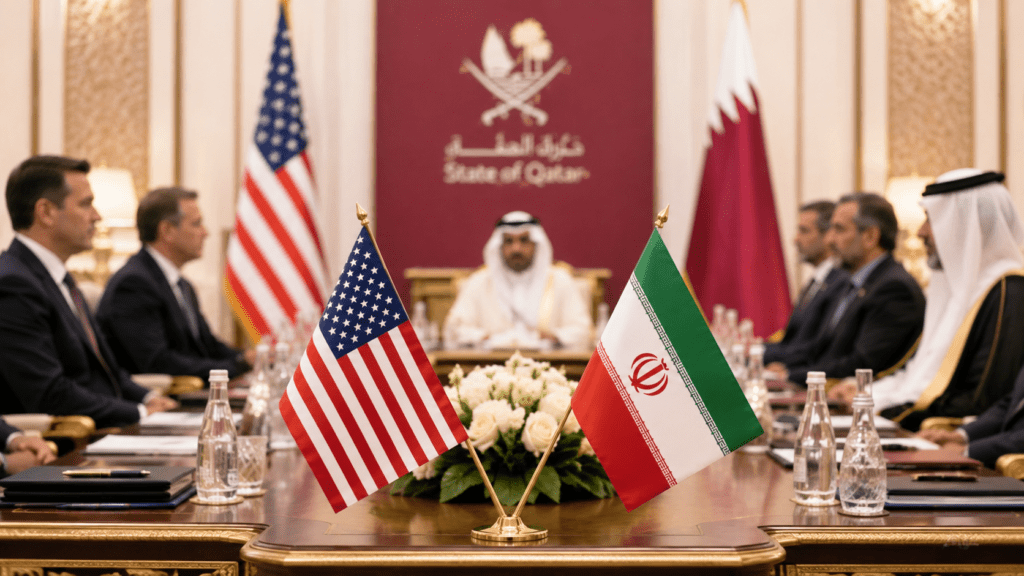
Instead, Qatar continues its role as a neutral mediator, hosting parallel technical discussions focused on implementing previously negotiated understandings rather than launching a new political dialogue.
According to Qatar’s Ministry of Foreign Affairs, U.S. Special Envoy Steve Witkoff and Jared Kushner, President Trump’s senior adviser and son-in-law, are meeting exclusively with Qatari mediators. Iranian officials have also stated publicly that their delegation has no plans to meet directly with American representatives during this phase.
Technical negotiations replace high-level diplomacy
Unlike earlier negotiations held in Switzerland involving senior political leaders, the Doha meetings are being described as technical consultations.
Rather than negotiating broad political agreements, specialists are expected to work on implementation details involving previously accepted principles.
Among the key subjects under discussion are:
- Implementation of the recently signed Memorandum of Understanding (MoU);
- Release of approximately $6 billion in frozen Iranian assets currently held in Qatar;
- Future mechanisms for easing financial restrictions;
- Maritime navigation through the Strait of Hormuz;
- Regional security coordination;
- Long-term discussions regarding Iran’s nuclear program.
Qatari officials emphasized that progress on financial issues remains linked to broader diplomatic implementation.
Conflicting public messages continue
One of the most notable aspects of the current diplomatic effort has been the difference in public messaging coming from Washington and Tehran.
President Donald Trump stated earlier this week that American representatives would meet Iranian officials in Doha.
However, Iranian Foreign Ministry spokesperson Esmaeil Baghaei rejected that characterization, saying that no meetings with U.S. officials are planned “at any level” in the coming days.
Qatar later clarified the situation by confirming that American representatives are present in Doha solely for consultations with mediators.
The differing narratives illustrate how public communication itself has become part of the diplomatic process, with each side carefully managing domestic and international expectations.
Frozen Iranian assets remain unresolved
One of the most closely watched issues involves billions of dollars in Iranian funds frozen abroad.
Qatari officials confirmed that approximately $6 billion in restricted Iranian assets have not yet been transferred to Tehran.
Officials explained that any release will depend on continued implementation of commitments established under the Memorandum of Understanding.
For Iran, these assets represent an important economic issue after years of sanctions.
For Washington and its regional partners, their release remains connected to broader diplomatic benchmarks.
Strait of Hormuz remains strategically important
Although commercial shipping continues moving through the Strait of Hormuz, international maritime organizations continue monitoring elevated security risks.
The Joint Maritime Information Center recently raised its maritime security assessment to “Substantial,” citing ongoing mine-clearance operations and persistent navigation risks.
Despite those concerns, commercial traffic has continued through both shipping corridors used by international vessels.
Iran maintains that any mine-clearance activities inside Hormuz fall under the existing Memorandum of Understanding and insists there is no need for foreign intervention in those operations.
Meanwhile, Qatar and Oman continue coordinating efforts designed to maintain safe maritime navigation.
Qatar strengthens its diplomatic role
The latest developments further reinforce Qatar’s growing importance as a regional diplomatic intermediary.
Together with Pakistan, Qatar has hosted several rounds of indirect discussions between Washington and Tehran over recent months.
Rather than serving only as a meeting location, Doha has become an active communication channel capable of carrying proposals, clarifications and implementation details between both governments without requiring direct political engagement.
This mediation model has helped preserve dialogue even during periods of heightened regional tension.
Regional implications extend beyond Iran
Although current discussions focus primarily on U.S.-Iran relations, developments are being closely monitored across the Middle East.
Officials from several Gulf countries continue evaluating how future agreements could affect:
- Regional energy markets;
- Maritime commerce;
- Financial sanctions;
- Security cooperation;
- Long-term political stability.
The outcome of these technical consultations may influence broader diplomatic initiatives involving neighboring states over the coming months.
ACT News Analysis
The meetings in Doha demonstrate that diplomacy often advances through technical work long before major political announcements become possible.
While headlines may focus on whether American and Iranian officials sit in the same room, the more significant developments frequently occur through mediators working on implementation details, financial mechanisms and confidence-building measures.
Another important takeaway is the increasingly central role played by middle-power countries such as Qatar. Rather than acting merely as hosts, these governments have become essential facilitators capable of keeping communication channels open even when direct dialogue remains politically difficult.
The differing public statements issued by Washington and Tehran also highlight how diplomatic messaging itself has become part of modern international strategy. Governments frequently communicate different narratives to domestic audiences while continuing practical discussions behind the scenes through intermediaries.
At the same time, unresolved issues—including frozen Iranian assets, maritime security in the Strait of Hormuz and future sanctions arrangements—remain critical indicators of whether current negotiations can eventually evolve into broader political agreements.
For international markets, energy producers and regional governments alike, the progress of these technical discussions could carry consequences extending well beyond U.S.-Iran relations.
Sources
- CNN International
- Qatar Ministry of Foreign Affairs
- Iranian Ministry of Foreign Affairs
- Joint Maritime Information Center (JMIC)
- Reuters
Analysis prepared by ACT News, combining verified reporting with independent editorial context and international affairs analysis.
Stay Connected
Follow ACT News for real-time updates, breaking stories, and in-depth coverage from around the world.
Never Miss a Story
Join our WhatsApp Channel and get breaking news straight to your phone.
Join WhatsApp Channel →