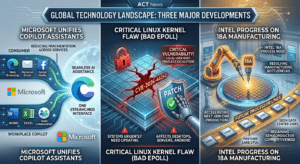
Major developments across artificial intelligence platforms, open-source security, and semiconductor manufacturing converged this week as Microsoft announced a major restructuring of its Copilot ecosystem, a critical vulnerability in the Linux kernel was disclosed and patched, and Intel reported progress on its advanced 18A manufacturing process. Together, the three events highlight accelerating competition in AI integration, cybersecurity resilience, and next-generation chip production.
Microsoft has moved to unify its Copilot applications into a single, consolidated entry point, merging consumer-facing and workplace productivity tools into one streamlined interface. The goal of the redesign is to reduce fragmentation across services and create a more seamless user experience for AI-assisted tasks, whether in personal computing, enterprise workflows, or cloud-based environments. According to the company’s positioning, the updated Copilot structure is intended to increase daily engagement with AI by making it more accessible and embedded in routine digital activity.
Industry analysts note that the consolidation reflects a broader strategy shift in the AI sector, where companies are competing not only on model capability but also on user experience and ecosystem control. By reducing the number of separate applications and entry points, Microsoft aims to strengthen retention and make its AI tools a default layer across productivity systems. The move also signals deeper integration between operating systems, cloud services, and generative AI assistants.
In parallel, the cybersecurity community has responded to the disclosure of a critical vulnerability in the Linux kernel, identified as CVE-2026-46242 and informally referred to as “Bad Epoll.” The flaw reportedly allows local users to escalate privileges to root level, potentially affecting a wide range of systems including desktop environments, enterprise servers, and Android-based devices.
Security researchers emphasized that the vulnerability is particularly significant due to the widespread use of the Linux kernel across global infrastructure. While a patch has already been released, system administrators are being urged to update immediately to mitigate potential exploitation. The incident highlights ongoing challenges in maintaining security across open-source ecosystems, where transparency enables rapid detection but also requires swift coordination across multiple distributions and vendors.
Meanwhile, Intel reported progress in resolving manufacturing bottlenecks related to its 18A process node, a key milestone in its roadmap for next-generation chip production. The improvement is expected to accelerate output for future processor lines, including Panther Lake CPUs and Xeon data center chips, as well as products developed under Intel Foundry Services.
The 18A process is central to Intel’s strategy to regain competitiveness in advanced semiconductor manufacturing, an area dominated by intense global competition. Industry observers suggest that improvements in yield and production stability could strengthen Intel’s position in both consumer and enterprise markets, particularly as demand for high-performance computing and AI-optimized chips continues to grow.
Taken together, these developments illustrate three parallel pressures shaping the global technology landscape: the rapid consolidation of AI interfaces, the persistent risks in foundational open-source infrastructure, and the strategic race for semiconductor manufacturing leadership. Each area carries significant implications not only for tech companies but also for governments and industries increasingly dependent on digital systems.
As AI becomes more integrated into everyday tools, security vulnerabilities continue to expose the fragility of underlying systems, while advancements in chip manufacturing remain critical to sustaining computational growth. The intersection of these trends underscores a technology sector evolving simultaneously toward greater integration, higher performance demands, and increased systemic risk.
Sources: Company announcements, cybersecurity bulletins, semiconductor industry reports
Stay Connected
Follow ACT News for real-time updates, breaking stories, and in-depth coverage from around the world.
Never Miss a Story
Join our WhatsApp Channel and get breaking news straight to your phone.
Join WhatsApp Channel →