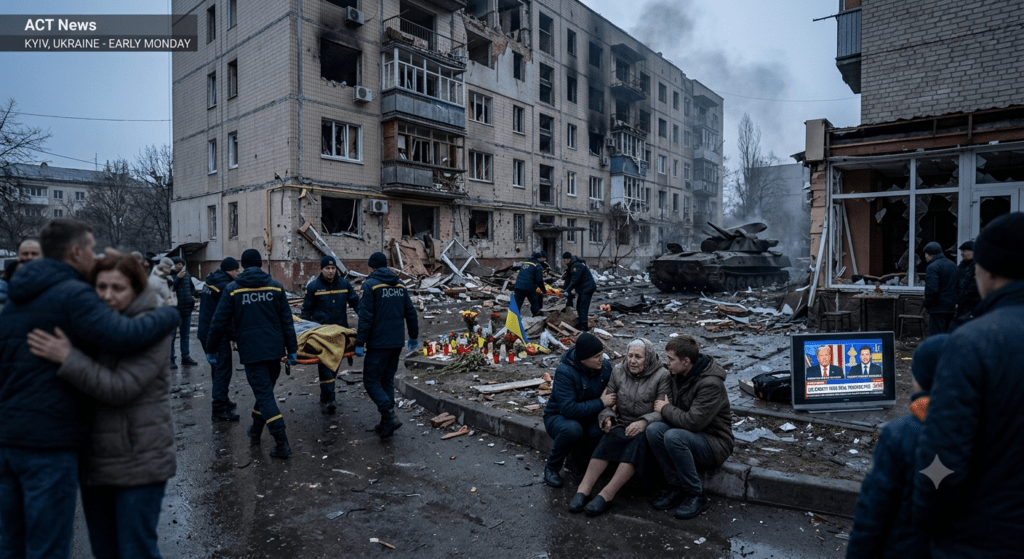
A renewed wave of missile and drone strikes by Russia on the capital of Ukraine killed at least 12 people in Kyiv early Monday, according to Ukrainian authorities, as the country continues to struggle with limited air defense capacity amid ongoing wartime pressure. The attacks come just days after what officials described as one of the deadliest strikes of the year, highlighting a sustained escalation in aerial warfare.
Ukrainian officials reported that the latest bombardment involved multiple waves of missiles and drones targeting key infrastructure and residential areas in Kyiv. Emergency services responded throughout the night, while rescue operations continued into the morning as debris was cleared and survivors were located. Authorities also warned that shortages of U.S.-made interceptor missiles are weakening Ukraine’s ability to counter incoming aerial threats effectively.
The shortage of air defense systems has become a central concern for Kyiv’s military planning. Officials have repeatedly emphasized that Western-supplied interceptors are critical for protecting urban centers, particularly as Russia increasingly relies on long-range drone and missile attacks. The latest strike has renewed urgency in diplomatic discussions over military aid deliveries and stockpile replenishment.
In parallel, geopolitical discussions involving the United States have added a new dimension to the conflict narrative. The President of the United States, Donald Trump, reportedly expressed willingness to assist Russian President Vladimir Putin in exploring a potential agreement framework with Ukraine. Ukrainian President Volodymyr Zelenskyy stated that recent conversations included what he described as a “real perspective” for ending the war, though no formal agreement has been announced.
The diplomatic signals come at a moment of heightened military pressure, creating a complex backdrop where battlefield developments and negotiation efforts are occurring simultaneously. Analysts note that while discussions involving major global leaders may indicate movement toward dialogue, the intensity of recent strikes suggests that conditions on the ground remain highly unstable.
Financial markets have also reacted to the broader geopolitical environment. Energy and commodity prices have fluctuated amid concerns about supply stability, while investors closely monitor developments in Eastern Europe alongside shifts in global production policies, including recent output adjustments by OPEC+ members. Market analysts suggest that sustained conflict in Ukraine continues to be a key factor influencing risk sentiment across global assets.
The situation in Kyiv underscores the persistent challenges facing Ukraine’s defense infrastructure as the war enters another phase of attritional aerial warfare. With air defense systems stretched and international military support under pressure, Ukrainian authorities warn that civilian populations remain highly vulnerable to continued strikes.
At the same time, emerging diplomatic dialogue adds uncertainty to the trajectory of the conflict, with stakeholders weighing the possibility of negotiations against ongoing battlefield escalation.
Sources: Reuters, Ukrainian government statements, international market reports
What impact do you think the combination of military escalation and diplomatic talks will have on the next phase of the war? Follow ACT News and share your opinion.
Stay Connected
Follow ACT News for real-time updates, breaking stories, and in-depth coverage from around the world.
Never Miss a Story
Join our WhatsApp Channel and get breaking news straight to your phone.
Join WhatsApp Channel →