By ACT News | International Coverage
📋 Executive Summary
| Axis | Today’s Highlight |
|---|---|
| U.S. Judiciary | Supreme Court expands Trump’s authority over the Fed, sets up rulings on transgender sports bans and campaign finance limits |
| Geopolitics | U.S. formalizes USMCA exit; Iran-Qatar diplomacy stalls after weekend strike exchanges |
| Global Economy | Wall Street closes a historic quarter; Germany pushes for $450B cut to “unaffordable” EU budget |
| Energy & Industry | Ferrari and BMW join Tesla, China in copper-to-aluminum shift; Washington targets Chinese energy investors |
| World Cup 2026 | Extreme “heat dome” threatens fans and players across the U.S.; Germany edges Paraguay on penalties |
| Africa | Anti-immigrant protests shut down South African cities; families split under deportation deadline |
| Ukraine | Four-year war is reshaping even local wildlife; Monaco bombing targets Ukrainian-born oligarch |
The Supreme Court Redraws Washington’s Power Map
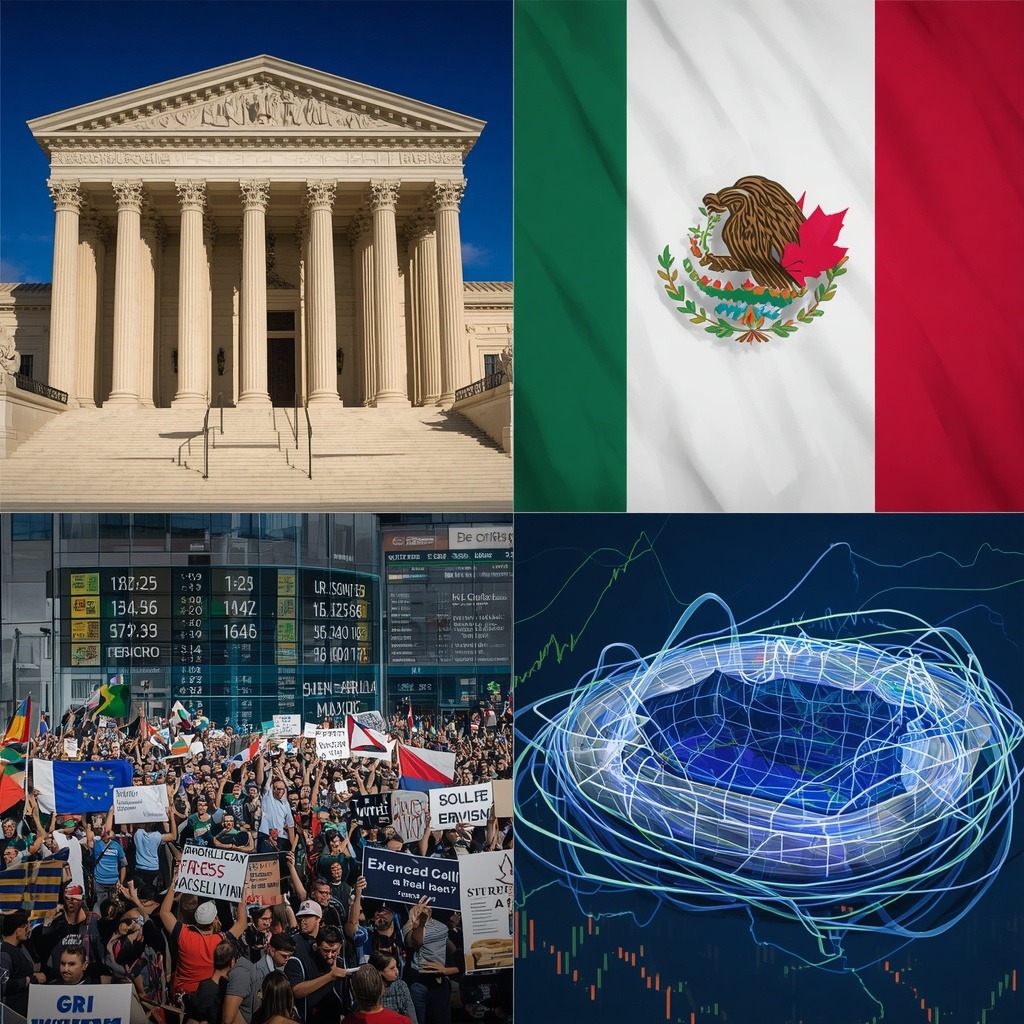
In a single session, the United States’ highest court took a decisive step toward strengthening President Donald Trump’s authority over institutions that, until recently, were largely shielded from direct political interference. The ruling involving the Federal Reserve is the most sensitive chapter of this shift: while justices preserved Fed Governor Lisa Cook’s seat on the central bank’s board, the Court simultaneously cemented broader legal tools that expand presidential influence over agencies long considered independent. Analysts already note that Cook’s partial win may, in practice, amount to a strategic victory for the White House, since the legal precedent set carries more long-term weight than the narrow outcome of her individual case — a distinction that matters greatly for how the Fed’s independence is interpreted going forward, especially as markets price in the central bank’s next moves on interest rates.
The decision’s reach extends well beyond the Fed. The same Supreme Court session signaled that two other deeply polarizing issues will reach the docket in the coming months: the legality of state-level bans on transgender athletes in competitive sports, and the constitutionality of Republican attempts to sidestep campaign spending limits. Both questions are likely to deepen an already fractured political climate ahead of a symbolically loaded year — the nation marks 250 years of independence at a moment when, according to analysts cited by U.S. outlets, the country may be too divided to celebrate the milestone as one.
North American Trade Enters a Decade-Long Countdown
Alongside this domestic judicial shift, Washington formalized its withdrawal from the USMCA, the free-trade agreement that replaced NAFTA and binds the U.S. to Canada and Mexico. The move carries no immediate effect: the agreement’s own text provides a ten-year transition window before the rupture becomes final, opening a decade of uncertainty for entire supply chains tied to trinational integration, from the auto industry to agriculture.
This unfolds just as Trump’s tariff policy shows mixed results in the real economy. At Whirlpool’s Iowa appliance plant, for instance, tariffs meant to shield American manufacturing jobs have failed to translate into meaningful hiring in the appliance sector — a sign that the equation between protectionism and job creation is far from automatic, a tension that continues to complicate the administration’s broader economic narrative heading into the second half of the year.
Iran, Qatar, and a Fragile Ceasefire Balance
In the Middle East, the ceasefire established on June 17 between Iran and its regional adversaries remains tested by weekend exchanges of strikes. The arrival in Doha of Jared Kushner, Trump’s son-in-law, alongside special envoy Steve Witkoff, underscores Qatar’s growing role as mediator, though the opacity surrounding these talks leaves analysts split on how durable the provisional agreement really is.
The regional picture grows more complicated with skepticism surrounding the Israel-Lebanon understanding. Experts warn the deal may, paradoxically, freeze the conflict rather than resolve it: Hezbollah has categorically refused disarmament, and no Lebanese government currently holds the leverage to enforce that condition. The result is a ceasefire largely in name, as southern Lebanon continues to see smoke rise from recurring Israeli strikes, with no clear path toward lasting pacification.
In Europe, NATO is balancing two boards at once: Turkish officials publicly reinforce that the alliance is adapting to the new regional security landscape and that the U.S. shows no sign of retreating from its European commitments, while joint naval drills off the U.S. East Coast — deliberately timed to coincide with the nation’s 250th anniversary — aim to project transatlantic unity at the very moment that unity faces its sharpest questioning back home in Washington.
Wall Street Closes a Historic Quarter Amid Mixed Signals
Global markets wrapped up a quarter that will be remembered as one of the strongest in recent years: U.S. stocks surged, while the dollar lost ground to both gold and the Japanese yen, reflecting elevated risk appetite among investors. Massive AI-related spending, optimistic corporate earnings expectations, and hopes for Fed rate cuts form the three pillars expected to define the mood on U.S. equities through the second half of the year — a dynamic that will keep traders watching the Fed’s next CPI and inflation readings as closely as any geopolitical headline.
That optimism, however, coexists with warning signs. The intensity of selling in tech shares during certain sessions has reignited fears of a bubble in the sector — a concern that echoes prior AI hype cycles and could become the central source of instability should earnings expectations fail to materialize.
On the European side, Germany has hardened its fiscal stance within the EU, demanding roughly $450 billion in cuts to what it calls an “unaffordable” community budget — a move that further strains the bloc’s budget negotiations amid widespread economic pressure. In Russia, the strain is even more visible in public sentiment: a Gallup survey found economic pessimism among Russians at its highest level in at least two decades, an indicator that complicates the Kremlin’s internal narrative of economic resilience under prolonged sanctions.
Auto Industry Switches Metals, Energy Sector Shifts Geopolitics
In the auto sector, a quiet but significant migration is gaining momentum: Ferrari and BMW are joining Tesla and Chinese automakers in switching from copper to aluminum wiring — a direct response to rising copper costs and pressure for leaner margins in an industry already navigating the electric transition. Meanwhile, Ford announced a recall of more than 741,000 vehicles in the U.S. over a flaw identified in the parking system, according to the National Highway Traffic Safety Administration (NHTSA).
In energy, Washington is advancing a measure that could reshape the foreign investment map: a ban specifically targeting Chinese investors in U.S. energy assets, including solar installations. The move comes alongside Trump’s personal pressure campaign on gasoline retailers to lower prices, with an explicit warning that the sector will face “big trouble” if it fails to comply — a posture blending direct market intervention with political messaging aimed squarely at American consumers.
Pharma Industry Faces Congressional Scrutiny
The U.S. House of Representatives launched an investigation into clinical trials conducted by Merck and AbbVie in China, raising the regulatory spotlight on major global pharmaceutical companies. The move comes just as the White House pushes its agenda to lower drug prices — a goal running into resistance from mid-sized pharmaceutical firms, which lack the scale to absorb margin cuts without compromising research and development.
World Cup 2026: Extreme Heat and Penalty-Shootout Drama
Excitement around the FIFA World Cup 2026 carries a troubling counterpoint: a “heat dome” threatens to turn matches across the Midwest and East Coast into tests of physical endurance, with heat indexes projected between 105°F and 115°F, putting both athletes and fans at risk inside stadiums.
On the pitch, Germany delivered one of the tournament’s most dramatic moments yet, edging out Paraguay in a historic penalty shootout. Off the field, the World Cup continues to reveal human stories beyond the sport itself: in California, a traditional soccer stronghold, the tournament has become a genuine seismic event of public mobilization, while in the Czech countryside, an unlikely Argentine fan has become a symbol of unwavering faith under the banner “In Messi We Trust.” Amid the competitive fervor, Dutch player Cody Gakpo publicly reminded fans that life holds priorities far more important than the outcome of a match — a reflection that resonated across fanbases of multiple national teams.
South Africa Under Strain: Anti-Immigration Deadline Splits Families
South African cities woke up paralyzed by a wave of anti-immigrant protests, with demonstrators wrapped in flags and carrying wooden clubs marching across the country under heavy police guard, amid scattered outbreaks of violence. The trigger was an informal deadline set by anti-immigration groups demanding that undocumented foreigners leave the territory — a demand with no formal legal backing, but one already producing concrete human consequences.
The case of Malawian national John Allen illustrates the human toll behind the headlines: facing mounting pressure, he had to hastily say goodbye to his South African partner and their one-year-old child to board a bus out of the country. Cases like his are multiplying nationwide, reigniting debate over the structural roots of xenophobia in South Africa and how representative these protests truly are of broader public sentiment.
Ukraine: Four Years of War Are Rewriting Even Nature Itself
More than four years into Russia’s invasion, the war in Ukraine has already altered local wildlife patterns. Researchers documented birds building nests from fragments of destroyed fiber-optic cable near the front line — an image that has become a quiet symbol of how deeply the conflict permeates every layer of the ecosystem, from geopolitics to biology.
On the diplomatic front, President Volodymyr Zelensky sharpened his criticism of Russia’s approach to peace talks, stating that the Kremlin has set and broken fifteen different deadlines for capturing the Donbas region over the course of the conflict — an accusation that reinforces Ukrainian distrust of any Russian gesture toward a negotiated solution.
The war has also produced shockwaves far beyond Ukrainian territory: authorities in Monaco and France launched a manhunt for a bombing suspect after an explosion injured three people in the wealthy principality. Two sources indicate the attack targeted a Ukrainian-born oligarch, suggesting that disputes tied to the conflict are now reaching well beyond its borders and striking directly at global financial centers linked to Eastern European fortunes.
UK May Block Blockbuster $110 Billion Hollywood Merger
Finally, on the international corporate radar, the British government has signaled it may intervene in a $110 billion deal between Paramount and Warner Bros Discovery. A potential UK intervention would add a transatlantic regulatory layer to one of the largest mergers ever proposed in the entertainment sector, with the power to reshape the balance of power between major Hollywood studios and regulators outside the United States.
#ACTNews #SupremeCourt #Trump #FederalReserve #USMCA #Iran #Ukraine #SouthAfrica #WallStreet #WorldCup2026 #Geopolitics #Markets #NATO #EuropeanUnion
Stay Connected
Follow ACT News for real-time updates, breaking stories, and in-depth coverage from around the world.
Never Miss a Story
Join our WhatsApp Channel and get breaking news straight to your phone.
Join WhatsApp Channel →