ACT News | International Analysis
The international landscape is entering another period of rapid transformation as governments confront simultaneous humanitarian, geopolitical, economic and environmental challenges. From Latin America to Europe, the Middle East and Asia, the latest developments demonstrate how interconnected today’s world has become, with decisions made in one region increasingly influencing stability, markets and public confidence across the globe.
While each event follows its own national context, together they reveal broader trends shaping international affairs in 2026: greater pressure on governments to respond quickly to crises, renewed diplomatic engagement after periods of confrontation, increasing climate-related challenges, and growing uncertainty in the global economy.
Venezuela Faces One of Its Most Difficult Humanitarian Emergencies
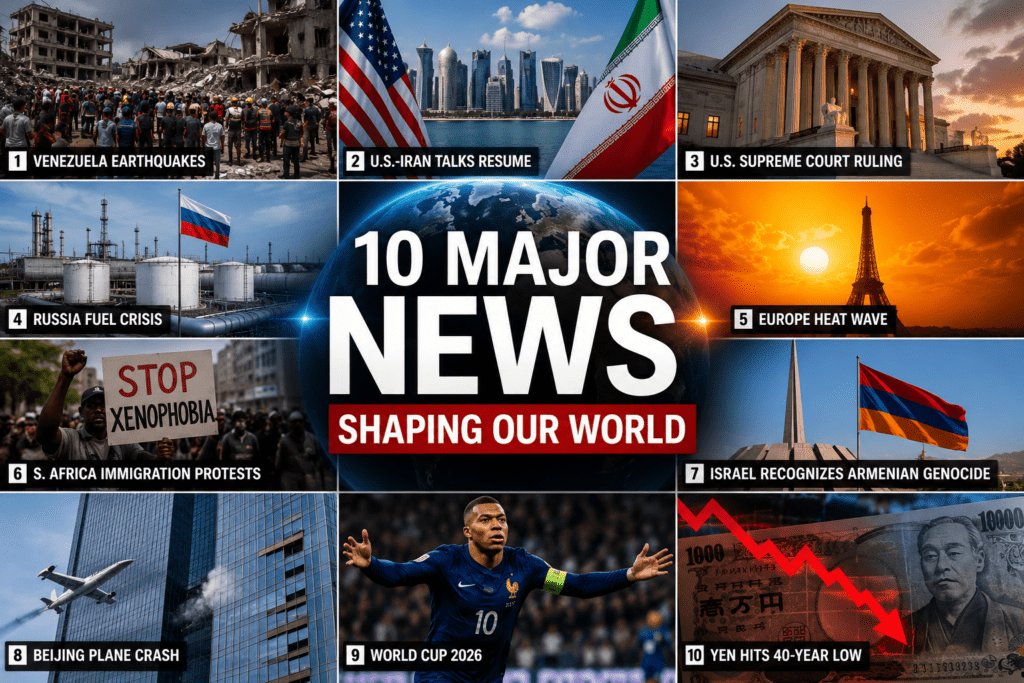
Venezuela remains at the center of international attention after two powerful earthquakes caused extensive damage across several regions of the country.
Authorities continue rescue and recovery operations while hospitals, ports and public facilities have been converted into temporary emergency centers to support the overwhelming number of victims and displaced residents.
Beyond the immediate humanitarian response, reconstruction is expected to become a long-term challenge requiring significant financial resources, international cooperation and infrastructure investment. The disaster also highlights the growing importance of disaster preparedness in countries with vulnerable infrastructure.
For Latin America, the recovery effort may become one of the region’s largest humanitarian operations in recent years.
Washington and Tehran Return to Diplomacy
Following several days of heightened military tensions, the United States and Iran have agreed to resume indirect negotiations in Qatar.
Although expectations briefly increased regarding possible direct talks, Qatari officials confirmed that discussions continue through mediators rather than face-to-face meetings between both delegations.
The decision to return to diplomacy signals that both governments recognize the importance of maintaining communication channels despite ongoing disagreements.
ACT News Analysis
Diplomatic engagement should not be interpreted as an immediate breakthrough. Instead, it represents a practical effort to reduce uncertainty while exploring limited areas of cooperation.
For global energy markets, even incremental diplomatic progress can contribute to greater confidence and reduce fears surrounding regional stability.
U.S. Supreme Court Reinforces Birthright Citizenship
One of the most significant legal developments in the United States came as the Supreme Court upheld birthright citizenship, rejecting efforts to restrict automatic citizenship for children born on American soil.
The decision preserves a long-standing constitutional interpretation and reinforces existing legal protections under the Fourteenth Amendment.
The ruling is expected to influence future immigration debates while also shaping political discussions ahead of upcoming legislative initiatives.
ACT News Perspective
Rather than ending the national debate, the ruling shifts the discussion toward Congress, where lawmakers may pursue alternative legislative proposals.
The decision illustrates how constitutional questions continue to play a central role in American public policy.
Russia Faces Growing Pressure on Energy Infrastructure
Russia acknowledged increasing pressure on parts of its fuel supply following continued drone attacks targeting energy infrastructure.
Although authorities emphasize that essential production continues, the situation illustrates how prolonged conflicts increasingly affect logistics, transportation and industrial planning.
Energy remains one of Russia’s most strategic sectors, meaning any sustained disruption has implications extending well beyond domestic markets.
Europe Experiences Historic Heat
Several European countries continue experiencing unusually high temperatures.
France has reported a significant increase in heat-related mortality, while Switzerland, Denmark and Germany have recorded new temperature records.
Scientists continue emphasizing that more frequent extreme weather events require stronger adaptation policies, resilient healthcare systems and improved emergency planning.
ACT News Analysis
Climate events are no longer isolated environmental stories—they increasingly influence public health, labor productivity, tourism, agriculture, insurance markets and government spending.
As temperatures continue rising globally, heat resilience may become one of Europe’s most important public policy priorities.
Immigration Debate Intensifies in South Africa
Large demonstrations opposing immigration have generated tensions in parts of South Africa, prompting security measures and temporary displacement of migrant communities.
The events highlight broader discussions regarding employment, economic inequality and social cohesion.
Governments across multiple regions continue balancing border management with humanitarian responsibilities, making migration one of the defining policy issues of this decade.
Israel Officially Recognizes the Armenian Genocide
Israel’s formal recognition of the Armenian Genocide represents a significant diplomatic development.
The decision has generated criticism from both Turkey and Azerbaijan while receiving support from governments and organizations that have long advocated broader international recognition.
ACT News Perspective
Historical recognition often extends beyond symbolic politics.
Such decisions can reshape diplomatic relationships, influence regional alliances and affect future negotiations across multiple areas of foreign policy.
Aviation Safety Under Renewed Attention Following Beijing Incident
Authorities in China continue investigating an aviation accident involving a small aircraft that collided with Beijing’s CITIC Tower.
Emergency responders reacted quickly while investigators focus on determining the factors that contributed to the incident.
The aviation industry closely monitors investigations of this nature, as findings frequently contribute to future improvements in operational safety standards.
World Cup 2026 Continues Capturing Global Attention
The FIFA World Cup remains one of the world’s largest sporting events.
France impressed supporters with an outstanding performance led by Kylian Mbappé in its victory over Sweden, while Brazil continues final preparations for an important match against Norway.
Beyond the competition itself, the tournament continues generating substantial economic activity through tourism, broadcasting rights, sponsorship agreements and digital engagement worldwide.
ACT News Analysis
Major sporting events increasingly function as economic platforms, strengthening international branding, consumer spending and technological innovation across multiple industries.
Japanese Yen Reaches Four-Decade Low
Financial markets continue closely monitoring Japan after the yen weakened to its lowest level against the U.S. dollar in approximately forty years.
The depreciation has increased speculation regarding possible government or central bank intervention aimed at stabilizing currency markets.
Currency movements of this scale influence international trade, investment decisions, import costs and corporate earnings throughout Asia and beyond.
Global Trends Connecting Today’s Headlines
Although these stories originate from different regions, they collectively illustrate several important global trends:
- Humanitarian resilience remains a growing international priority following natural disasters and climate-related emergencies.
- Diplomatic engagement continues to play a critical role in reducing geopolitical uncertainty.
- Constitutional institutions remain influential in shaping domestic and international policy debates.
- Energy security continues affecting both economic performance and geopolitical strategy.
- Climate adaptation is becoming increasingly central to national planning.
- Global financial markets remain sensitive to currency fluctuations and energy developments.
- International sporting events continue serving as drivers of economic activity and global engagement.
ACT News Editorial Perspective
The defining characteristic of today’s international environment is not a single crisis but the convergence of multiple global challenges occurring simultaneously.
Natural disasters, diplomatic negotiations, judicial decisions, financial volatility and climate events are increasingly interconnected through trade, technology, supply chains and international cooperation.
Governments capable of combining economic resilience, diplomatic dialogue, infrastructure investment and long-term strategic planning will likely be better positioned to navigate this evolving landscape.
For businesses, investors and citizens alike, understanding these broader connections has become just as important as following individual headlines. Rather than viewing these developments in isolation, the international community is witnessing a period where local events increasingly produce global consequences.
Follow ACT News for independent international analysis, trusted reporting, and in-depth coverage of the stories shaping our world every day.
Stay Connected
Follow ACT News for real-time updates, breaking stories, and in-depth coverage from around the world.
Never Miss a Story
Join our WhatsApp Channel and get breaking news straight to your phone.
Join WhatsApp Channel →