July presents a dense combination of observational astronomy, planetary science missions, and deep-space research milestones. From planetary alignments visible to the naked eye to advanced space telescopes studying dying-star survivors, the month reflects a growing intersection between public astronomy and high-level astrophysical research.
Institutions such as NASA, ESA, and the James Webb Space Telescope continue to drive both public engagement and scientific discovery.
Planetary alignment guide and naked-eye observations
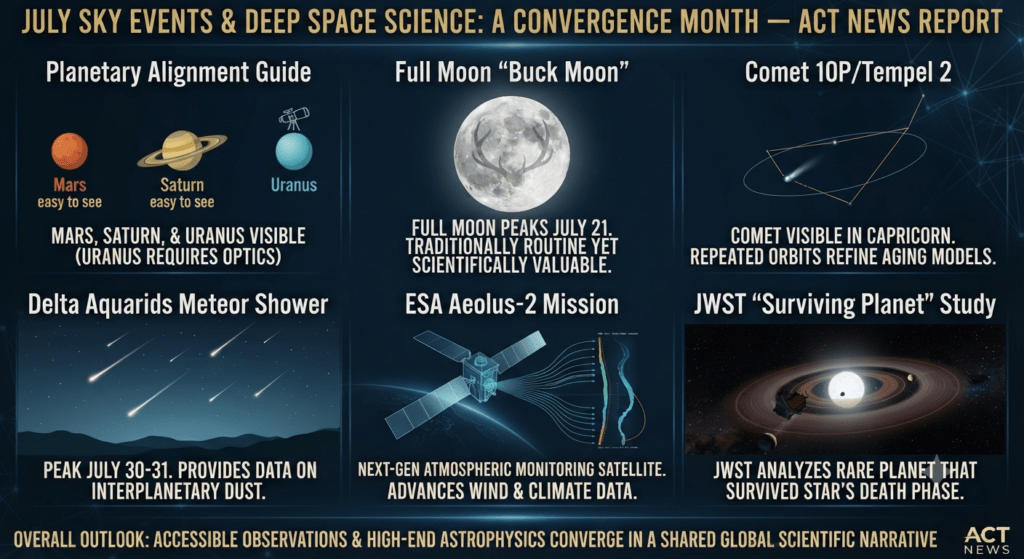
NASA has released a July observing guide highlighting a notable planetary alignment involving Mars, Saturn, and Uranus.
While Mars and Saturn can be observed with relative ease under dark skies, Uranus typically requires binoculars or a small telescope, making this alignment both accessible and partially technical for amateur astronomers.
ACT News perspective:
This type of alignment does not indicate unusual gravitational interactions, but it does significantly increase public interest in observational astronomy, often driving higher participation in citizen science programs.
Full Moon “Buck Moon” and lunar visibility
The Buck Moon, the traditional name for July’s full moon, will peak around July 21. This lunar phase is one of the most widely observed events in the annual sky calendar and is often associated with seasonal changes in the Northern Hemisphere.
Observation note:
While scientifically routine, full moons remain culturally and scientifically important as they offer stable reference points for lunar surface imaging and long-term observation campaigns.
Comet 10P/Tempel 2 passes through Capricorn
The periodic comet 10P/Tempel 2 is expected to be visible during July as it travels through the constellation Capricorn.
This comet is part of a well-documented group of Jupiter-family comets, and its repeated returns allow astronomers to refine models of cometary aging, outgassing behavior, and orbital evolution.
ACT News analysis:
Although not a visually dominant object for casual observers, its predictable orbit makes it valuable for long-term studies of solar system dynamics.
Delta Aquarids meteor shower peak
The Delta Aquarids meteor shower is expected to reach peak activity between July 30 and 31, offering consistent meteor rates under dark-sky conditions.
Meteor showers like this occur when Earth passes through debris trails left by comets, producing streaks of light as particles enter the atmosphere at high speed.
ACT News perspective:
This event also provides indirect data on interplanetary dust distribution, which is important for spacecraft shielding design.
ESA advances atmospheric monitoring with Aeolus-2
The ESA has authorized the Aeolus-2 mission, a next-generation satellite designed to improve global atmospheric wind measurement and climate modeling.
Building on the original Aeolus mission, this upgraded system aims to deliver more precise data on wind patterns, which are critical for weather forecasting and climate research.
ACT News analysis:
Aeolus-2 represents a shift toward higher-resolution Earth observation systems that combine climate science with operational meteorology.
James Webb studies a “surviving planet” system
The James Webb Space Telescope is currently analyzing a rare planetary system where a planet appears to have survived the death phase of its host star.
This type of system is extremely valuable for understanding long-term planetary survival mechanisms during stellar evolution, particularly during red giant expansion phases.
ACT News perspective:
Such observations help refine models of planetary system stability and may inform predictions about the long-term fate of systems like our own solar system.
Overall outlook: July as a convergence month for astronomy
Across observational astronomy and advanced space research, July highlights three major trends:
First, public engagement is increasing through visible sky events such as planetary alignments, lunar phases, and meteor showers.
Second, space agencies are prioritizing atmospheric and planetary science missions with practical Earth applications.
Third, deep-space telescopes are expanding understanding of planetary survival and system evolution.
From an ACT News standpoint, the significance lies not in any single event, but in how accessible sky observations and high-end astrophysics are increasingly part of the same global scientific narrative — one visible from backyards and space observatories alike.
Stay Connected
Follow ACT News for real-time updates, breaking stories, and in-depth coverage from around the world.
Never Miss a Story
Join our WhatsApp Channel and get breaking news straight to your phone.
Join WhatsApp Channel →