The global space sector is entering a new phase of rapid consolidation and intensified launch activity, marked by large-scale satellite deployments, commercial competition in low-Earth orbit, and strategic mergers that could redefine market leadership in the coming years. Recent missions from major aerospace companies highlight both the technological momentum and the growing geopolitical and economic weight of orbital infrastructure.
Atlas V completes final Amazon Kuiper-related deployment segment
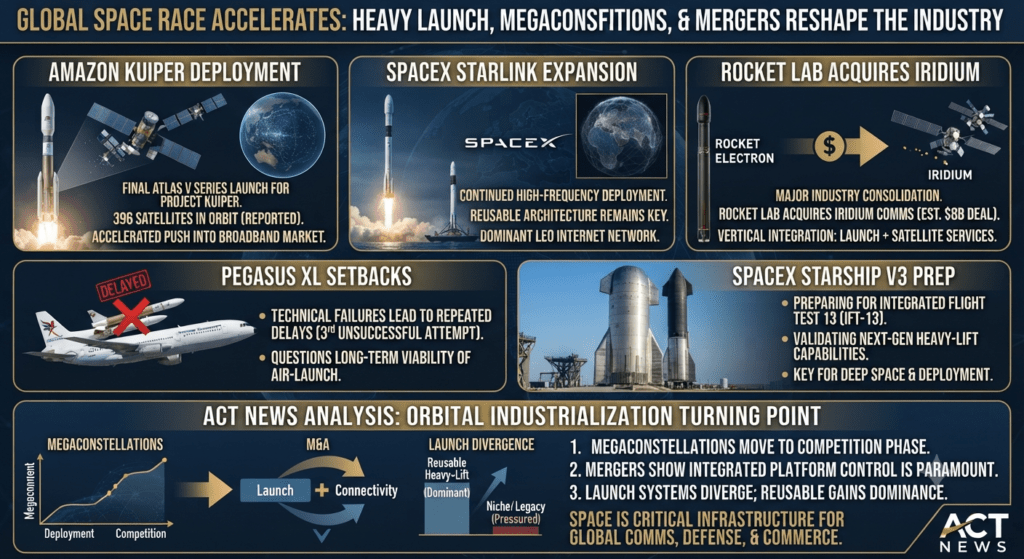
The Atlas V rocket, operated by United Launch Alliance, successfully launched a batch of 29 satellites for Amazon’s Project Kuiper, marking what industry observers describe as a final major contribution of this launch series to the expanding broadband constellation. With this mission, the Kuiper network reportedly reaches 396 satellites in orbit.
From a strategic perspective, this milestone signals Amazon’s accelerated push into the satellite internet market, directly challenging established players. The increasing density of Kuiper’s orbital assets suggests a transition from experimental deployment to early-stage operational coverage, although full global service still depends on further launches and ground infrastructure expansion.
Amazon’s initiative is led through Amazon, which continues to diversify beyond e-commerce into high-value space infrastructure services.
SpaceX maintains launch cadence with Starlink expansion
In parallel, SpaceX successfully launched the Starlink 17-46 mission, deploying additional satellites for its already dominant low-Earth orbit internet network. The booster landing at Vandenberg further demonstrates the company’s continued emphasis on reusable launch architecture, which remains central to its cost advantage.
From ACT News’ analytical standpoint, SpaceX’s operational model is increasingly becoming the benchmark for commercial launch efficiency. The combination of rapid turnaround, high launch frequency, and vertical integration reinforces its dominance, though rising competition from Amazon’s Kuiper and emerging Asian providers may gradually reshape the market balance.
Pegasus XL Swift Boost delayed again after technical failure
The Pegasus XL Swift Boost mission, operated by Northrop Grumman, experienced another delay following a technical malfunction during pre-launch procedures. This marks the third unsuccessful attempt for the mission in this configuration.
Repeated setbacks raise broader questions about the long-term viability of air-launched small payload systems in an era increasingly dominated by reusable heavy-lift rockets. While Pegasus historically played a pioneering role in flexible orbital access, current market dynamics appear less favorable to its cost structure.
Rocket Lab moves into major consolidation with Iridium acquisition
One of the most significant developments in the commercial space industry is the reported acquisition of Iridium Communications by Rocket Lab in a deal valued at approximately US$8 billion.
If completed, this would represent one of the largest mergers in the modern space economy, effectively combining launch capability with an established satellite communications network. The strategic implication is clear: Rocket Lab is positioning itself not just as a launch provider, but as an integrated space infrastructure company.
From an ACT News perspective, this reflects a broader industry shift toward vertical integration, where companies seek to control both access to orbit and the services delivered from space. This model mirrors earlier phases of the tech industry, where platform control became more valuable than hardware alone.
SpaceX prepares next-generation Starship test flight
Looking ahead, SpaceX is preparing for Starship Integrated Flight Test 13, the second flight of the upgraded V3 architecture. The test is expected toward the end of July and is seen as a critical step in validating next-generation heavy-lift capabilities.
Starship remains central to SpaceX’s long-term vision, including deep space missions and high-capacity satellite deployment. However, technical complexity and development risks remain significant, meaning each test flight carries both engineering and strategic importance.
ACT News Analysis: a turning point in orbital industrialization
Taken together, these developments suggest that the commercial space sector is entering a phase of accelerated industrial consolidation. Three key trends stand out:
First, satellite megaconstellations are transitioning from deployment to competition, with Amazon and SpaceX moving toward large-scale operational networks.
Second, mergers and acquisitions, such as the Rocket Lab–Iridium deal, indicate that control over data and connectivity is becoming as important as launch capability itself.
Third, launch systems are diverging: reusable heavy-lift platforms are gaining dominance, while legacy and niche systems face increasing economic pressure.
In our assessment at ACT News, the next five years will likely determine whether the space economy evolves into a small number of dominant integrated giants or remains a fragmented ecosystem of specialized providers. What is already clear is that space is no longer an experimental frontier—it is becoming critical infrastructure for global communications, defense, and commerce.
Stay Connected
Follow ACT News for real-time updates, breaking stories, and in-depth coverage from around the world.
Never Miss a Story
Join our WhatsApp Channel and get breaking news straight to your phone.
Join WhatsApp Channel →