GLOBAL — JULY 2026
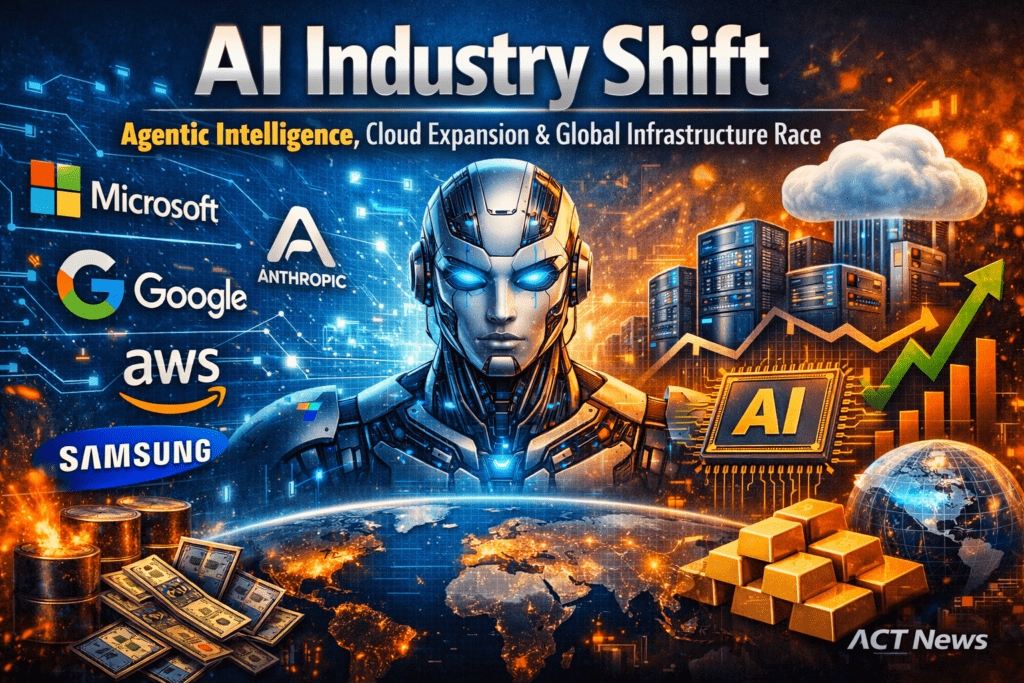
A new wave of artificial intelligence development is reshaping the global tech ecosystem, as major companies accelerate toward “agentic AI systems,” new cloud integrations, and large-scale industrial partnerships.
Recent announcements from Microsoft, Anthropic, Google, AWS, and Samsung-linked ecosystems indicate that the AI race is no longer centered only on model performance — but on infrastructure, organization, and economic integration.
🚨 BREAKING: Claude AI models integrated into Microsoft Foundry ecosystem
Microsoft has officially expanded its AI ecosystem by integrating Anthropic’s Claude models into Microsoft Foundry, strengthening its position in enterprise AI infrastructure.
According to industry updates:
- Claude models are now accessible through Microsoft’s cloud AI stack
- enterprise clients can deploy multi-model AI systems
- integration is designed for large-scale organizational AI workflows
📌 Source: Microsoft AI ecosystem announcement (June 30, 2026)
👉 ACT News Analysis:
This move confirms a strategic shift away from single-model dependency. Microsoft is building a multi-provider AI infrastructure model, where competition becomes internalized inside its own ecosystem.
⚙️ The “Agentic AI” era: the real challenge is no longer models, but organizations
Recent industry commentary highlights a major shift in AI development philosophy: the next bottleneck is not model intelligence, but organizational adaptation.
Key insights from AI infrastructure reports:
- companies struggle to integrate AI into real workflows
- productivity gains depend on structural redesign, not model size
- “agentic AI” requires human-AI hybrid systems
📌 Source: AWS ecosystem analysis (July 2, 2026)
👉 ACT News Analysis:
AI is transitioning from a tool to a decision-layer inside organizations. Companies that fail to restructure workflows will not benefit from even the most advanced models.
🤖 Anthropic expands Claude 5 ecosystem and removes key restrictions
Anthropic has launched updates to its Claude 5 family, including expanded capabilities and reduced operational restrictions in certain deployments.
Industry reporting highlights:
- broader access to Claude Sonnet 5
- expanded enterprise applications
- new AI safety and deployment configurations
📌 Source: Anthropic product release notes (July 1, 2026)
👉 ACT News Analysis:
This reflects a balancing act between capability expansion and controlled deployment, as AI systems become more integrated into sensitive business environments.
🧠 Google and Amazon: rising energy cost of AI infrastructure
Recent environmental and technology analysis points to increasing concerns about the real cost of AI expansion, particularly in large-scale cloud infrastructure.
Key findings:
- rising electricity demand from AI data centers
- water consumption for cooling systems increasing globally
- sustainability concerns in long-term AI scaling
📌 Source: Industry climate and AI infrastructure reports (June 25–30, 2026)
👉 ACT News Analysis:
AI is no longer a purely digital sector — it is becoming a physical resource-intensive industry, similar to manufacturing or energy production.
🇰🇷 Korea announces massive AI chip and semiconductor expansion plan
South Korea has unveiled a large-scale investment strategy in AI-related semiconductors, involving major corporations including Samsung and SK Hynix.
Key elements:
- multi-hundred-billion-dollar AI chip development plan
- focus on next-generation inference hardware
- strengthening national semiconductor independence
📌 Source: regional tech and economic briefing (June 29, 2026)
👉 ACT News Analysis:
The AI race is increasingly becoming a chip sovereignty competition, where national governments and corporations converge.
🔬 Google expands generative AI image systems with Nano Banana Lite 2
Google has introduced updated generative image tools under its AI ecosystem expansion strategy.
Key developments:
- improved image generation performance
- lightweight model optimized for broader use
- integration into creative AI workflows
📌 Source: Google AI update report (July 1, 2026)
👉 ACT News Analysis:
Generative AI is moving toward mass accessibility, reducing barriers for creative and commercial use cases.
🌐 Global synthesis — ACT NEWS AI STRUCTURAL VIEW
Across all developments, three structural trends define the current AI era:
1. AI is becoming an organizational system, not just a technology
Companies must redesign workflows, not just adopt tools.
2. Infrastructure is now the real battlefield
Cloud systems, chips, and energy define competitive advantage.
3. Multi-model ecosystems replace single AI dominance
Microsoft, AWS, and others are moving toward integrated AI marketplaces.
🧭 FINAL ACT NEWS COMMENTARY
The AI sector in 2026 is no longer defined by breakthroughs in model intelligence alone. Instead, it is shaped by:
- infrastructure control
- enterprise integration
- semiconductor independence
- organizational transformation
As ACT News analysis concludes:
The next phase of artificial intelligence is not about building smarter models — it is about building systems that societies and corporations can actually absorb at scale.
📌 ACT NEWS — AI & Global Technology Desk
📍 Sources: Microsoft Foundry updates, Anthropic release notes, AWS AI commentary, Google AI announcements, South Korea semiconductor strategy reports, and industry analysis briefings.
Stay Connected
Follow ACT News for real-time updates, breaking stories, and in-depth coverage from around the world.
Never Miss a Story
Join our WhatsApp Channel and get breaking news straight to your phone.
Join WhatsApp Channel →