⚠️ Iran doubles down on confrontation narrative as global tensions intensify amid leadership funeral and regional pressure
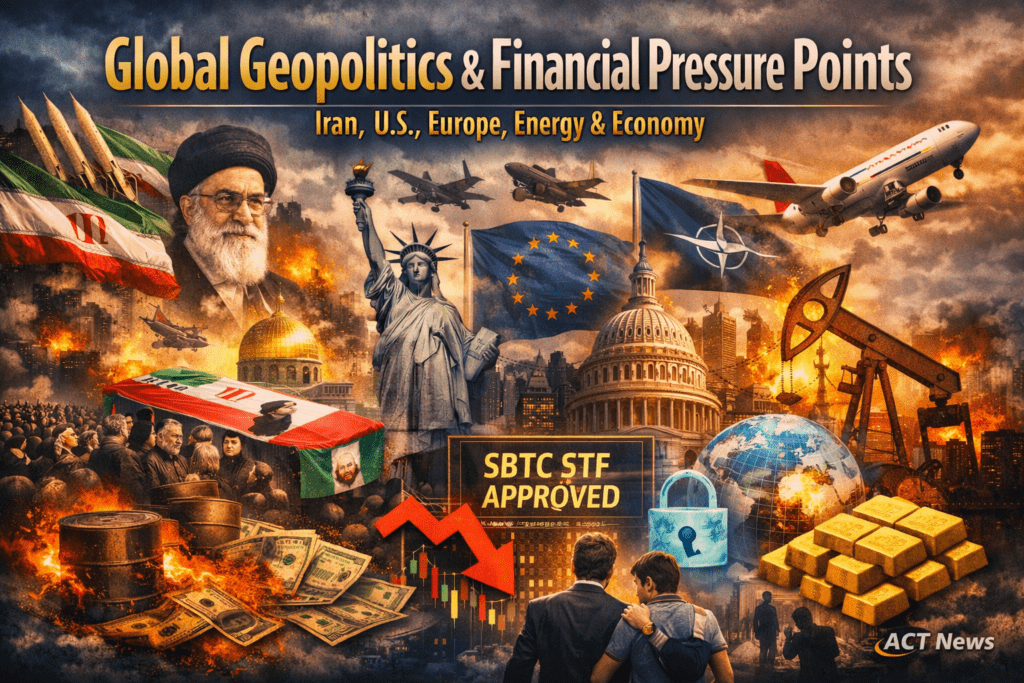
Tehran has entered a new phase of political messaging and international signaling as senior officials, military commanders, and foreign delegations gather for high-profile funeral ceremonies marking what Iranian state-aligned sources describe as a “martyr leader.”
Across multiple statements reported by regional media outlets, Iranian authorities have reinforced a hardened stance toward the United States and Israel, framing recent geopolitical tensions as a long-term structural confrontation rather than isolated incidents.
According to statements attributed to senior IRGC commanders, “unexpected and hard blows will continue” following the leadership transition, signaling continuity in Iran’s security doctrine rather than de-escalation.
At the same time, Iranian parliamentary speaker Mohammad Bagher Ghalibaf was quoted asserting that Iran would not allow U.S. intervention in the Strait of Hormuz, while also claiming that previous U.S.–Israel strategic pressure campaigns had failed to achieve their objectives.
Other reports highlighted mass funeral events across multiple Iranian cities, with officials describing widespread national unity and symbolic resistance messaging in response to external pressure.
Iranian narratives also referenced historical grievances, including renewed statements about the 1988 Airbus Flight 655 incident, which continues to be used as a political reference point in domestic discourse.
ACT News Analysis
From ACT News perspective, these developments illustrate a recurring pattern in Iranian foreign policy communication:
- Strong internal cohesion messaging during leadership transitions
- Strategic use of historical memory in diplomatic positioning
- Continued emphasis on deterrence over negotiation signaling
Rather than signaling immediate escalation, the messaging appears designed to reinforce internal legitimacy while projecting external resilience.
⚠️ Europe under strain as political fragmentation, defense disputes, and migration pressures intensify
In Europe, multiple parallel political developments reflect increasing institutional stress across the EU and NATO framework.
Recent reporting highlights tensions within NATO ahead of key strategic discussions, including disputes over infrastructure funding and continued support for Ukraine. At the same time, senior U.S. military restructuring signals under discussion have raised concerns among allied capitals regarding long-term security guarantees in Eastern Europe.
In Poland, growing attention has been placed on defense readiness and airspace security, as analysts warn of increasing hybrid pressure scenarios across the region.
Separately, European political discourse has intensified around governance disputes, with new debates emerging over national sovereignty, economic competitiveness, and migration policy.
ACT News Analysis
The European strategic environment is increasingly defined by three structural pressures:
- Security burden shifting between U.S. and European forces
- Internal EU political fragmentation
- Economic strain driven by energy transition and industrial competition
This combination is accelerating policy divergence within NATO and the EU, particularly on defense funding and Ukraine support strategies.
⚠️ Global economy faces layered shocks: layoffs, banking instability concerns, and AI-driven structural shifts
Global markets are simultaneously absorbing multiple economic pressure signals.
Reports indicate large-scale corporate layoffs across multinational companies, reaching hundreds of thousands of job reductions globally this year. Financial institutions are also facing increased regulatory pressure, with banks warning of rising operational and compliance risks linked to fraud, digital transformation, and tightening supervision.
In parallel, economic debate is intensifying around taxation reforms in several countries, with new legislative proposals under review in national parliaments.
A notable policy discussion also includes updated social benefit structures in some European systems, including pension-related adjustments and cost-of-living support mechanisms.
ACT News Analysis
The current global economic cycle shows characteristics of structural transition rather than short-term correction:
- Labor markets are adjusting to AI and automation
- Banking systems are under dual pressure from regulation and digital risk
- Governments are increasing fiscal intervention through taxation and redistribution
This suggests a longer-term rebalancing phase rather than a cyclical downturn.
📰 ARTICLE 2 — TECHNOLOGY, AI, CRYPTO & DIGITAL POWER SHIFT
⚠️ AI industry enters agentic phase as Microsoft, Anthropic, AWS and Google reshape global tech competition
The artificial intelligence sector continues to evolve rapidly into what industry analysts increasingly describe as the “agentic AI era,” where systems move beyond models into autonomous decision-making frameworks.
Recent developments include the availability of Anthropic Claude models in Microsoft Foundry, signaling deeper integration between frontier AI labs and enterprise infrastructure ecosystems.
At the same time, AWS and Microsoft discussions around organizational AI scaling suggest that the next bottleneck in AI adoption is not model capability, but corporate structure and deployment strategy.
Additional reporting highlights:
- Google and Amazon facing scrutiny over the real energy cost of AI infrastructure
- Anthropic exploring hardware partnerships for custom chips with Samsung
- Continued expansion of generative AI applications across business and consumer markets
ACT News Analysis
The AI sector is entering a structural transition phase defined by three key dynamics:
- Shift from model competition → infrastructure competition
- Rising importance of energy efficiency and compute optimization
- Integration of AI into organizational decision layers (agentic systems)
This marks a shift from “AI as tool” to “AI as operational layer.”
⚠️ Crypto markets stabilize while regulatory uncertainty and tokenization debates intensify
The cryptocurrency sector is experiencing a complex mix of stabilization and regulatory uncertainty.
Recent market reports show Bitcoin maintaining recovery levels around the $60,000 range, supported by renewed ETF inflows after a period of sustained outflows.
However, regulatory discussions are intensifying globally:
- The IMF warns that tokenization could either strengthen or fragment the global financial system depending on policy choices
- Stablecoin-related consortium disputes highlight governance uncertainty in digital currency initiatives
- Streaming and prediction-market manipulation concerns have triggered brand enforcement actions by major platforms
At the same time, new Web3 infrastructure projects and tokenized asset platforms continue to expand, particularly in real-world asset (RWA) ecosystems.
ACT News Analysis
Crypto markets are transitioning into a regulatory-defined phase rather than a purely speculative cycle:
- Institutional inflows are stabilizing volatility
- Regulatory frameworks are becoming the primary market driver
- Tokenization is emerging as the central long-term narrative
The sector is no longer driven only by retail speculation but increasingly by macro-financial integration.
⚠️ Cybersecurity and digital risk escalate as spyware, government hacks, and platform vulnerabilities emerge
Recent cybersecurity reports reveal increasing sophistication in surveillance and digital intrusion tools.
One major case involves a politician previously investigating spyware abuse reportedly becoming a target of Pegasus-related hacking activity, raising renewed concerns about state-level surveillance technology misuse.
Additional reports indicate repeated cybersecurity breaches affecting government systems, alongside growing vulnerabilities in digital infrastructure.
ACT News Analysis
The cybersecurity landscape is entering a phase where:
- Surveillance tools are increasingly democratized
- Political and institutional targets are expanding
- Digital infrastructure is becoming a strategic geopolitical domain
This reflects the convergence of intelligence operations, commercial spyware, and political conflict in the digital sphere.
FINAL ACT NEWS OUTLOOK
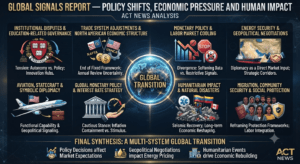
Across geopolitics, economics, AI, and crypto, a common pattern emerges:
- Rising geopolitical fragmentation
- Accelerating technological autonomy (AI agents, digital systems)
- Increasing financial system transformation via tokenization
- Expanding cybersecurity conflict as a parallel battlefield
From ACT News perspective, the world is moving into a phase where technology, finance, and geopolitics are no longer separate systems — but fully interconnected layers of the same global structure.
Stay Connected
Follow ACT News for real-time updates, breaking stories, and in-depth coverage from around the world.
Never Miss a Story
Join our WhatsApp Channel and get breaking news straight to your phone.
Join WhatsApp Channel →