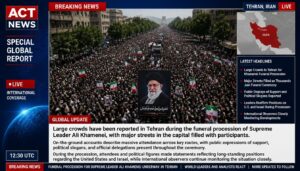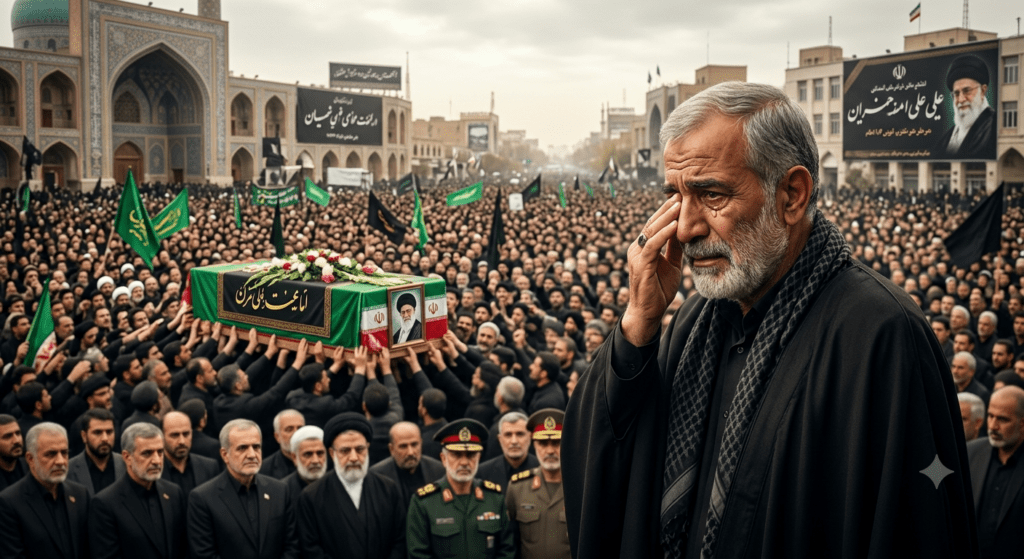
Iran is holding major funeral ceremonies for former Supreme Leader Ali Khamenei, drawing massive public participation and senior government attendance. The event is widely seen as both a national moment of mourning and a politically sensitive transition period closely watched by international observers.
🇮🇷 Notable absence sparks speculation
One of the most discussed aspects of the ceremony is the absence of Mojtaba Khamenei, the son of the late leader and a figure often mentioned in discussions about potential succession.
While other family members and senior officials attended the service, his absence has generated speculation in international media and political analysis circles.
No official explanation has been provided for his non-participation.
🏛️ Senior officials and mass public participation
High-ranking Iranian officials, including President Masoud Pezeshkian and other political and military leaders, attended the ceremonies.
Large crowds gathered in Tehran, with authorities describing the event as one of the largest public mourning gatherings in the country’s recent history.
Official estimates suggest that millions may participate across Iran and Iraq over several days, with additional processions planned in multiple cities.
🌡️ Logistics, crowd management and health response
The ceremonies are taking place under high temperatures and extremely dense crowds.
Medical teams have been deployed around key locations to respond to health incidents linked to heat exposure and crowd congestion, reflecting the scale of the gathering.
🗣️ Political messaging and public sentiment
The event has also carried strong political symbolism, with public expressions reflecting long-standing regional tensions and ideological positions.
At the same time, other participants have emphasized support for the former leader’s legacy and the political direction of the state.
🌍 International context and diplomatic backdrop
The funeral takes place amid ongoing geopolitical sensitivity in the Middle East, where diplomatic negotiations and regional tensions remain active.
Observers note that such large-scale ceremonies can also influence political messaging and regional alignments, depending on how succession and internal power structures evolve.
🧠 ACT News analysis: symbolism and transition dynamics
Beyond its religious dimension, the event highlights three key dynamics:
- Leadership transition uncertainty: absence of key figures raises questions about internal balance
- State symbolism: mass participation reinforces institutional continuity and national identity
- Geopolitical sensitivity: regional tensions amplify global attention
Together, these elements make the ceremony both a domestic milestone and a globally relevant political moment.
🔎 Conclusion
Iran’s funeral ceremonies reflect a complex intersection of mourning, political symbolism, and leadership transition, unfolding under intense international scrutiny.
📣 ACT News – Join the discussion
Do you think leadership transitions like this mainly reshape domestic politics, or also shift global geopolitics?
Follow ACT News for daily international coverage and analysis.
Stay Connected
Follow ACT News for real-time updates, breaking stories, and in-depth coverage from around the world.
Never Miss a Story
Join our WhatsApp Channel and get breaking news straight to your phone.
Join WhatsApp Channel →