Rising tensions across multiple fronts in the Middle East
A series of developments across Jerusalem, Gaza, Lebanon, Iran, and surrounding regions highlights a period of heightened diplomatic and security tension, according to reports from multiple international sources.
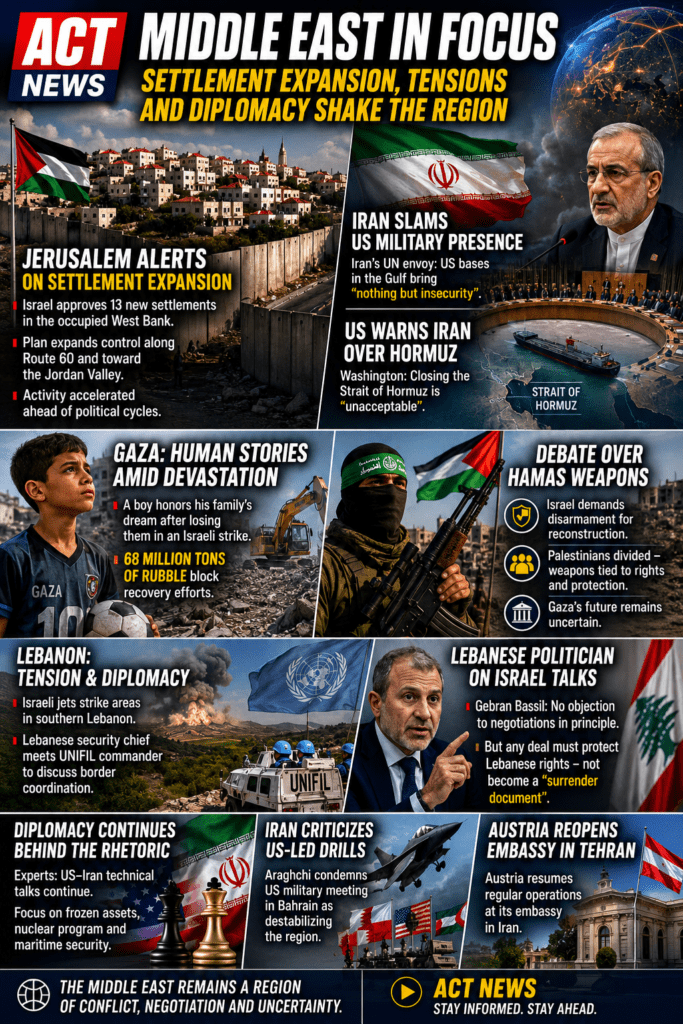
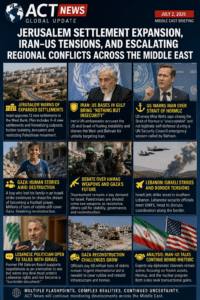
Jerusalem warns of expanded settlement activity in the West Bank
Authorities in Jerusalem have warned that Israel’s approval of 13 new settlements in the occupied West Bank may significantly expand settlement activity and further isolate the city from surrounding Palestinian areas.
The Jerusalem Governorate stated that the decision by Israel’s security cabinet reflects a broader pattern of accelerated settlement expansion ahead of political cycles. The initial phase, expected within months, could include the addition of four to six new settlements while formalizing existing outposts.
The plan reportedly covers strategic corridors northwest of Jerusalem toward Ramallah along Route 60, and eastward toward the Jordan Valley, increasing control over key roads and hills while limiting Palestinian movement in Area C.
A Washington-based Middle East think tank noted that settlement expansion in Area C has increased since 2022, alongside house demolitions and land seizures.
Iran raises concerns over US military presence in the Gulf
During an emergency session of the UN Security Council, Iran’s ambassador stated that US military bases in the Gulf region contribute “nothing but insecurity.”
Ambassador Amir-Saeid Iravani argued that the United States has no coastal borders in the region and accused Western members of the Security Council, as well as Bahrain, of unfairly blaming Iran for regional instability while ignoring actions attributed to the US and Israel.
He added that instead of addressing what he described as the root causes of regional tensions, some actors were attempting to shift responsibility away from ongoing conflicts.
US warns Iran over Strait of Hormuz escalation
The United States representative to the UN Security Council, Mike Waltz, warned Iran against any attempt to close the Strait of Hormuz during the same emergency session.
He stated that blocking international waterways would be unacceptable and cannot be considered legitimate self-defense.
The emergency meeting was reportedly convened at the request of Bahrain following repeated regional tensions attributed by some parties to Iranian activity.
Human impact in Gaza amid ongoing conflict discussions
In Gaza, humanitarian stories continue to emerge alongside broader political discussions.
One case highlighted a young boy who lost his parents and siblings in a strike while continuing to pursue his dream of becoming a football player, a goal supported by his family before their death.
Separately, local officials reported that millions of tons of rubble now cover large areas of Gaza, severely complicating reconstruction efforts. Estimates suggest around 68 million tons of debris remain across the territory, with urgent calls for international assistance to clear infrastructure and restore access to essential services.
Debate over Hamas weapons and Gaza’s future
Discussions about Gaza’s post-conflict future continue to center on the issue of armed groups.
Some Palestinian residents argue that weapons remain linked to broader political conditions and security concerns, while others insist that any future governance structure must prioritize stability, law enforcement, and reconstruction.
For Israel, disarmament is seen as a condition for reconstruction efforts and what it describes as a “new reality” in Gaza. Palestinian perspectives remain divided, reflecting broader uncertainty about long-term governance arrangements.
Lebanon: military coordination and border tensions
In southern Lebanon, Israeli air operations were reportedly conducted in areas between Barashit and Shaqra in the Bint Jbeil district, according to local sources.
At the same time, Lebanese Internal Security officials met with the head of the UN peacekeeping mission (UNIFIL) to discuss coordination along the southern border.
UNIFIL’s mandate is set to expire at the end of the year, raising questions about the future of its 48-year presence in the region. The mission has faced criticism from both Israeli and Lebanese actors regarding its effectiveness and mandate interpretation.
Lebanese political voices on negotiations with Israel
Former Lebanese Foreign Minister Gebran Bassil stated that he does not oppose negotiations with Israel in principle, describing them as an alternative to renewed conflict.
However, he emphasized that any agreement must preserve Lebanese rights and avoid becoming what he described as a “surrender document.” He also warned that assigning certain responsibilities to the Lebanese army in relation to armed groups could create internal tensions.
Bassil added that while negotiations may be possible, concerns remain regarding implementation details, guarantees of withdrawal, and broader political balance in any framework agreement.
Gaza reconstruction challenges intensify
Gaza’s municipal authorities report that the scale of destruction is severely limiting recovery efforts.
Officials stressed that debris removal remains a top priority to reopen roads and restore emergency access. However, they noted that the magnitude of destruction requires significant international coordination and long-term investment to rebuild basic infrastructure and housing.
Analysis: Iran–US diplomacy continues behind public rhetoric
Analysts cited in regional reporting suggest that diplomatic channels between the United States and Iran remain active despite public statements.
According to international relations experts, technical negotiations have continued, focusing on issues such as frozen Iranian assets, regional maritime routes including the Strait of Hormuz, and the broader nuclear program.
Observers note that both sides appear to have incentives to maintain dialogue, even amid public disagreements, as negotiations remain highly transactional in nature.
Regional escalation narratives and broader geopolitical context
Across multiple theaters—including Gaza, Lebanon, the Gulf, and the West Bank—the situation reflects overlapping tensions involving state actors, non-state groups, and international stakeholders.
Key issues include:
- Expansion of Israeli settlement activity in the West Bank
- Ongoing instability in Gaza and reconstruction challenges
- Maritime and nuclear tensions involving Iran and the United States
- Continued military activity in southern Lebanon
- Political debates within Lebanon regarding negotiations and security strategy
Conclusion
The developments reported across the region indicate a continued phase of geopolitical pressure and fragmented diplomacy. While some actors emphasize negotiation and stabilization, others remain focused on deterrence, territorial control, and security restructuring.
ACT News will continue monitoring these developments as regional dynamics evolve.
Stay Connected
Follow ACT News for real-time updates, breaking stories, and in-depth coverage from around the world.
Never Miss a Story
Join our WhatsApp Channel and get breaking news straight to your phone.
Join WhatsApp Channel →