The Middle East is entering another pivotal chapter as diplomatic initiatives, military operations, nuclear oversight, and maritime security increasingly intersect. Within the span of a single day, major developments involving the United States, Israel, Lebanon, Iran, and the United Nations underscored both the opportunities for diplomacy and the persistent risks of renewed confrontation.

By ACT News | Additional reporting based on regional officials and international media sources
According to information compiled by ACT News from official government statements and multiple international sources, regional leaders continue to pursue parallel tracks of negotiation and military preparedness, highlighting the fragile balance that currently defines the security environment across the Eastern Mediterranean and the Persian Gulf.
Washington Agreement Establishes New Framework Between the United States, Israel and Lebanon
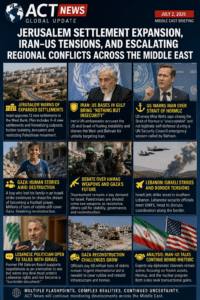
One of the most significant diplomatic developments came from Washington, where representatives from the United States, Israel, and Lebanon finalized a new framework intended to reduce hostilities along the Israel-Lebanon frontier.
The agreement follows months of negotiations after one of the deadliest periods of cross-border violence in recent years. More than 4,000 people have reportedly lost their lives during the broader conflict, while thousands of others have been displaced from communities on both sides of the border.
Officials involved in the negotiations described the accord as an important step toward lowering military tensions while creating mechanisms designed to prevent accidental escalation.
The framework reportedly includes expanded communication channels, security coordination, confidence-building measures, and continued diplomatic engagement under international supervision.
Although officials welcomed the agreement, analysts caution that its long-term success will depend on consistent implementation and political willingness from all parties involved.
Israel Signals It Will Maintain Military Presence in Southern Lebanon
Despite the diplomatic breakthrough, Israel has made clear that its military strategy remains unchanged for now.
Israeli Defense Minister Israel Katz stated that Israeli forces will continue operating in southern Lebanon for as long as security conditions require.
According to Israeli officials, maintaining military positions near the border remains necessary to prevent renewed attacks and protect northern Israeli communities.
The announcement came despite reports that several international partners, including the United States, have encouraged additional steps aimed at reducing military deployments following the Washington agreement.
Israeli authorities insist that any future adjustments will depend entirely on security assessments rather than political pressure.
The statement illustrates the continuing gap between diplomatic negotiations and military realities on the ground.
Iran Criticizes Washington’s Negotiating Position
Meanwhile, diplomatic tensions between Tehran and Washington remain unresolved.
Iranian officials accused the United States of adopting what they described as inconsistent and contradictory negotiating positions during ongoing discussions covering regional security and implementation of previous understandings.
A spokesperson for Iran’s Foreign Ministry argued that negotiations have slowed because of changing American positions regarding several unresolved issues.
Iran continues to insist that any lasting regional arrangement must respect previously negotiated commitments while recognizing its security interests.
American officials have maintained that discussions remain active but emphasize that any broader agreement must include effective verification mechanisms and regional security guarantees.
Despite the sharp exchange of statements, diplomatic contacts between both governments have not been suspended.
Trump Claims Iran Violated Ceasefire Through Maritime Drone Activity
Adding another layer of complexity, U.S. President Donald Trump accused Iran of violating the current ceasefire environment after Iranian drones allegedly targeted commercial shipping operating near the Strait of Hormuz.
According to the White House, unmanned aerial vehicles linked to Iran approached vessels navigating one of the world’s most strategically important maritime corridors.
The Strait of Hormuz remains essential to global energy markets, carrying a significant portion of international oil exports every day.
Iranian officials have rejected accusations that they deliberately violated ceasefire understandings and continue to argue that maritime security in the region should operate under previously negotiated arrangements.
The differing accounts illustrate the continuing lack of trust between Washington and Tehran despite ongoing diplomatic contacts.
Security experts warn that even isolated maritime incidents could rapidly escalate if communication channels fail.
United Nations Confirms Nuclear Inspection Role
Amid heightened regional tensions, the International Atomic Energy Agency (IAEA) reaffirmed that it will continue overseeing inspections of Iran’s nuclear facilities under the latest diplomatic arrangements.
IAEA Director General Rafael Grossi stated that inspections remain an essential component of international verification efforts.
According to the agency, technical preparations are already underway, and inspectors are expected to resume access to relevant facilities under internationally agreed procedures.
International officials view independent verification as one of the most important confidence-building measures capable of reducing uncertainty surrounding Iran’s nuclear activities.
The United Nations continues to emphasize that transparency and verification remain fundamental pillars of any sustainable diplomatic solution.
Regional Stability Faces Multiple Challenges
Taken together, the latest developments reveal a region balancing cautious diplomacy against continuing military uncertainty.
While the Washington agreement between the United States, Israel, and Lebanon represents a significant diplomatic milestone, military deployments along the Lebanese border remain unchanged.
At the same time, disagreements between Washington and Tehran continue to complicate broader negotiations, while allegations involving maritime security in the Strait of Hormuz demonstrate how quickly regional tensions can resurface.
The renewed commitment by the International Atomic Energy Agency to oversee Iran’s nuclear program offers one area where international cooperation continues despite wider geopolitical disagreements.
Diplomats believe that maintaining dialogue across multiple fronts—including Lebanon, maritime security, and nuclear oversight—will be essential to preventing future escalation.
International Community Continues Close Monitoring
Governments across Europe, the Gulf region, and the United Nations continue monitoring the evolving situation closely.
Security analysts note that the coming weeks could prove decisive as negotiators attempt to transform temporary understandings into more durable regional arrangements.
For now, diplomacy remains active, military forces remain on alert, and international institutions continue working to prevent isolated incidents from developing into broader regional confrontations.
As events continue to unfold, ACT News will keep following developments through official government announcements, international organizations, and multiple independent news sources to provide accurate and timely coverage of one of the world’s most closely watched geopolitical crises.
Stay Connected
Follow ACT News for real-time updates, breaking stories, and in-depth coverage from around the world.
Never Miss a Story
Join our WhatsApp Channel and get breaking news straight to your phone.
Join WhatsApp Channel →