The global space sector is entering a highly dynamic moment, shaped by rapid satellite deployment, rising commercial consolidation, and an unusual spike in solar activity affecting Earth’s near-space environment. Across multiple missions and agencies — including SpaceX, Amazon, Rocket Lab, and international space agencies — the pace of activity suggests that orbital infrastructure is expanding faster than at any point in recent years.
At the same time, space weather monitored by NOAA has intensified, adding a natural layer of complexity to an already crowded orbital environment.
Rapid satellite expansion: megaconstellations continue scaling
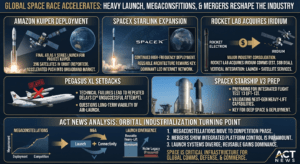
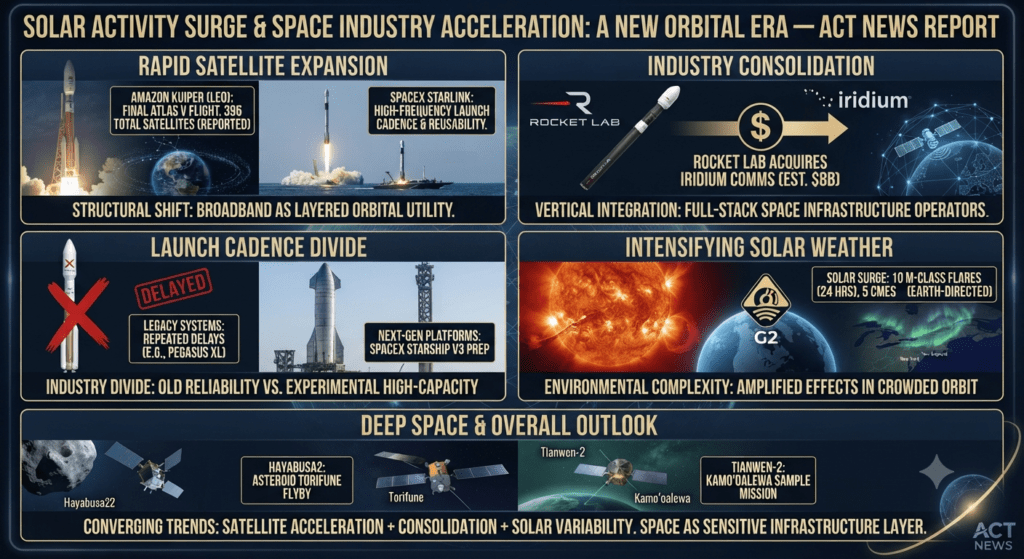
One of the most significant developments comes from the final Atlas V mission supporting Amazon’s low Earth orbit broadband system. The launch placed 29 additional satellites into orbit, bringing the total Amazon Leo constellation to 396 units. This marks the final flight in this specific launch series tied to the Kuiper deployment architecture, signaling a transition toward newer launch providers and vehicles in future phases.
Meanwhile, SpaceX continued expanding its Starlink network with mission 17-46. The booster successfully completed a landing at Vandenberg, reinforcing the company’s reusable launch strategy and maintaining its high launch cadence.
From a broader perspective, the simultaneous expansion of competing satellite networks highlights a structural shift: broadband connectivity is becoming a layered orbital utility rather than a niche service.
ACT News perspective:
The competitive pressure between Amazon and SpaceX is accelerating deployment speed, but it also increases congestion risks in low Earth orbit. Coordination frameworks may struggle to keep pace with commercial scaling.
Industry consolidation: Rocket Lab and Iridium reshape the market
A major commercial milestone came with the reported acquisition of Iridium Communications by Rocket Lab in a deal valued at approximately $8 billion.
If fully realized, this would represent one of the largest mergers in modern space communications history, combining Iridium’s established global satellite network with Rocket Lab’s launch and manufacturing capabilities.
ACT News analysis:
This type of vertical integration suggests a maturing industry where launch providers are no longer just service companies, but full-stack space infrastructure operators. The long-term effect may be fewer but larger players controlling end-to-end orbital ecosystems.
Launch delays and next-generation vehicles
Not all developments have proceeded smoothly. The Pegasus XL Swift Boost mission experienced its third delay due to technical issues, reflecting ongoing challenges in maintaining reliability for legacy launch systems.
In parallel, SpaceX is preparing Starship Integrated Flight Test 13. The V3 configuration is expected toward the end of July and is widely seen as a critical step toward validating full-scale deep-space transport capabilities.
ACT News perspective:
The contrast between repeated delays in older systems and rapid iteration in next-generation platforms highlights a clear industry divide: experimental high-capacity systems are advancing quickly, while smaller heritage programs struggle to maintain cadence.
Solar activity intensifies: Earth faces geomagnetic disturbance
In a separate but scientifically significant development, the Sun has produced 10 M-class solar flares within 24 hours, including five coronal mass ejections directed toward Earth.
According to monitoring by NOAA, these events are expected to trigger a G2-class geomagnetic storm, which can affect satellite operations, navigation systems, and high-frequency communications.
As a visible consequence, auroral activity is forecast across 19 US states, including regions as far south as New York, Michigan, and parts of New England.
ACT News analysis:
While G2 storms are not considered extreme, the timing is notable given the rapid expansion of satellite infrastructure. Even moderate solar disturbances can have amplified effects when orbital density is high.
Deep space missions: lunar and asteroid exploration advance
Two important scientific missions are also progressing:
- Japan’s Hayabusa2 is preparing a flyby of asteroid Torifune, marking a record-close approach scheduled for July 5.
- China’s Tianwen-2 has begun operations around Kamoʻoalewa, a quasi-satellite of Earth, with plans to collect and return surface samples.
ACT News perspective:
These missions reflect a growing focus on small-body exploration, which is increasingly seen as strategically important for both scientific research and future resource utilization.
Overall outlook: a crowded and sensitive orbital era
Taken together, these developments reveal three converging trends:
- Acceleration of satellite megaconstellations
- Consolidation of commercial space companies
- Increasing environmental variability from solar activity
While each trend is individually manageable, their overlap creates a more complex operational environment for satellites, navigation systems, and future missions.
From an ACT News standpoint, the most important takeaway is not any single launch or flare, but the systemic interaction between them. Space is no longer a static frontier — it is becoming a continuously active infrastructure layer above Earth, where commercial, scientific, and natural forces increasingly intersect.
Stay Connected
Follow ACT News for real-time updates, breaking stories, and in-depth coverage from around the world.
Never Miss a Story
Join our WhatsApp Channel and get breaking news straight to your phone.
Join WhatsApp Channel →