On the 1,586th day of full-scale war, Ukraine’s security services revealed the operational architecture behind a 40-day pressure campaign; Zaporizhzhia absorbed multiple guided munitions in a single morning; a senior field commander was found without signs of life; and Kyiv deepened its defense partnership with Kuwait while declaring the so-called Spirit of Anchorage diplomatically dead
June 28, 2026 — Ukraine’s Constitution Day — began not with celebration but with fire. In the predawn hours, long-range drone systems operated by Ukraine’s Security Service in coordination with the Unmanned Systems Forces and Military Intelligence reached two of Russia’s major oil-processing facilities simultaneously, setting ablaze sites that help fund the very war being waged against Ukrainian cities. ACT News has been tracking the cascade of events that unfolded across the following 18 hours, and the picture that emerges is one of a conflict entering a new phase of industrial and logistical attrition — one with direct consequences for global energy markets and for the diplomatic calculus surrounding any eventual peace negotiation.
The 40-Day Campaign: How Ukraine Framed Constitution Day as a Military Statement
The strike on the Slavyansk oil refinery in Russia’s Krasnodar region was carried out as part of a 40-day operation of sustained pressure on Russia by fighters from the Alpha special operations center of the Security Service of Ukraine, together with the Unmanned Systems Forces of the Armed Forces of Ukraine, the Main Intelligence Directorate, and other components of Ukraine’s Defense Forces. The Slavyansk-EKO facility, located more than 300 kilometers from Ukraine’s state border, specializes in the production of gasoline, fuel oil, and marine fuel, and serves as a key exporter through Black Sea ports. Gazeta do Povo
The deliberate framing of the operation as part of Constitution Day was not incidental. In his statement, Zelensky said Ukrainian forces had “begun Constitution Day with great accuracy,” describing the strikes as “long-range sanctions” — a phrase that reframes an act of warfare as an instrument of economic coercion, legally and rhetorically distinct from a conventional attack. Brasil de Fato
The Slavyansk refinery has a processing capacity of approximately 100,000 barrels of crude oil per day. The attack triggered fires in the crude oil storage area, the petroleum products storage area, and at the facility’s primary oil processing unit, according to Ukraine’s Security Service. CNN Portugal
A second facility in Russia’s Yaroslavl region, located roughly 700 kilometers from the Ukrainian border and approximately 250 kilometers northeast of Moscow, was also struck. The Yaroslavl strike prompted temporary road restrictions on routes approaching the Russian capital, while the Yaroslavl airport briefly suspended operations, consistent with Russia’s established protocol for aerial activity in the region. TMC
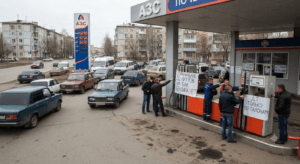
The strategic logic behind Ukraine’s energy campaign is measurable. Russia is currently facing a growing fuel shortage exacerbated by months of Ukrainian drone operations on oil refineries. More than 20 Russian regions have imposed restrictions on fuel sales, and many Russians have reported hours-long wait times at service stations. According to Western analysts cited by ABC News, the campaign has also slowed Moscow’s battlefield logistics, heaping pressure on the Kremlin to engage seriously with any negotiation framework. TMC
Titan-Barrikady: Ukraine’s Flamingo Missiles Find Another Target
The refinery strikes were only one dimension of what Ukrainian forces accomplished in a 36-hour window. The day before — on June 27 — Ukraine’s Rocket Forces and Artillery units struck the Titan-Barrikady Federal Research and Production Center in Volgograd using domestically developed FP-5 Flamingo missiles.
Titan-Barrikady is a major defense enterprise that manufactures self-propelled launchers and transport-loading vehicles for the Iskander-M ballistic missile system, as well as launchers for the Yars and Topol-M strategic missile systems, and large-caliber artillery howitzers. It is the same Iskander-M system Russia has regularly used to strike Ukrainian cities throughout the war. Galaxia Militar
The General Staff confirmed fires and partial destruction in two of the three workshops struck at the complex. Volgograd’s governor acknowledged an attack on “production facilities,” reporting 10 people received medical treatment, while Russia’s Defense Ministry made no mention of the missile strike in its official summary. ELTIEMPO
Ukraine’s Security Service concluded its statement on the Titan-Barrikady strike with an explicit declaration of intent: “Russia must understand a simple principle: the longer it wages its war of aggression against Ukraine, the higher the price of that aggression will be.” Correio da Manhã
Zaporizhzhia Under Sustained Pressure
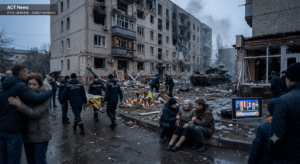
While Ukraine’s long-range operations drew international attention, the front-line city of Zaporizhzhia endured one of its most difficult days in weeks. Russian forces employed guided aerial munitions — commonly referred to as glide bombs — against the city in multiple separate incidents throughout the morning and early afternoon.
The first glide bomb impact struck a residential district, leaving three people requiring urgent medical attention. A subsequent strike was significantly more consequential: body fragments were recovered from the rubble of a collapsed structure, and the overall toll climbed through the afternoon. By early evening, confirmed figures stood at two persons with irreversible outcomes and 16 requiring medical care, with one child reported in serious condition, according to Ukrainian emergency services cited by Ukrinform.
The geographic logic of these strikes is significant for American readers tracking the conflict. Zaporizhzhia sits fewer than 25 kilometers from the active front line in several directions, and less than 40 kilometers from the Russian-occupied Zaporizhzhia Nuclear Power Plant — the largest such facility in Europe. Any miscalculation in the densely targeted zone around the city carries implications that extend far beyond the local civilian population.
A Brigade Commander Found Dead: Circumstances Under Investigation
One of the most operationally sensitive developments of June 28 received relatively little international coverage: the body of Colonel Volodymyr Kononnikov, commander of Ukraine’s 154th Separate Mechanized Brigade, was found without signs of life. The discovery was confirmed by Ukraine’s Operational Command South.
According to preliminary information made available to Ukrainian media, no signs of violence were detected on the officer’s body. Law enforcement has ordered an official investigation, and priority investigative actions are underway. The command publicly urged media and the public to refrain from spreading unverified information and to respect the privacy of the deceased’s family, describing Kononnikov as “an officer devoted to Ukraine and the military cause, a responsible commander who cared for the personnel and the needs of his military unit.” Infobae
The circumstances surrounding a senior field commander’s death during active operations — regardless of cause — carry institutional weight in any military. Ukraine’s command structure has experienced significant pressure at the unit-command level throughout the war’s fifth year, and the timing of this development, during a day of simultaneous large-scale operations, adds complexity to an already demanding operational environment.
241 Clashes, a Police Officer Down, and Kuwait Enters the Picture
The scale of ground-level activity on June 28 defies easy summary. Over the preceding 24 hours, 241 combat engagements were recorded across the front line. Russian forces launched one missile strike using four missiles and 88 aerial strikes, dropping 277 guided aerial bombs, while also deploying 9,873 long-range unmanned aerial systems against Ukrainian positions and settlements. Ukrainian air defenses intercepted all six Iskander-M ballistic missiles and 125 of 142 drones launched against the country overnight. Wikipedia
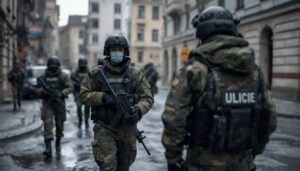
In Kharkiv — Ukraine’s second-largest city, located fewer than 30 kilometers from the Russian border — a Russian drone system struck a high-rise building, causing structural damage. During a civilian evacuation operation in the broader Kharkiv region, a police officer was killed and a colleague sustained injuries requiring medical treatment.
The Dnipropetrovsk region was subjected to more than 40 separate engagements in a single day, resulting in casualties. Wikipedia
On the diplomatic and military-cooperation front, Foreign Minister Andrii Sybiha announced a new phase of formalized military partnership between Ukraine and Kuwait — a development that would have seemed improbable just 18 months ago. Kuwait’s interest in Ukrainian defense technology, particularly its drone-interception systems and long-range unmanned platforms, reflects the Gulf state’s own concerns about aerial threats from Iran, making Ukraine an unexpectedly relevant security partner for Arab nations navigating the Gulf’s ongoing geopolitical instability.
Meanwhile, Sybiha responded directly to Kremlin statements about the so-called Spirit of Anchorage, the informal diplomatic understanding allegedly reached between Trump and Putin in Alaska last year. The foreign minister’s message was unambiguous: whatever framework Russia believes it negotiated in Alaska, Kyiv does not consider it binding, does not consider it alive, and will not allow it to serve as the opening position of any future talks.
Russia’s Fuel Crisis and the American Economic Connection
The convergence of Ukraine’s energy campaign and the ongoing situation in the Strait of Hormuz is producing a dual-pressure dynamic on global oil supply that the Federal Reserve cannot ignore as it calibrates its next interest-rate decision. Ukraine’s sustained campaign against Russian oil infrastructure has already cut at least 17 percent of Russia’s refining capacity, deepening a nationwide fuel shortage that is increasingly affecting Russian military logistics. TMC
For American consumers, the downstream question is whether continued Ukrainian pressure on Russian export capacity — combined with any renewed disruption in the Hormuz corridor — could push Brent crude back above the threshold that translates into visible pump-price increases. Western analysts who track the Kremlin’s economic resilience point out that Russia’s budget depends on energy revenues in a way that is becoming structurally unsustainable under the current pace of Ukrainian operations.
According to the Associated Press, Putin himself acknowledged on June 28 that Russia is going through a “difficult period” — a characterization notable for its rarity from a leader who has consistently projected confidence in the war’s trajectory. That the acknowledgment came on the same day Ukrainian drones were setting his country’s refineries ablaze was not a coincidence that the Kremlin’s communications team could easily manage. CNN Brasil
ACT News will continue monitoring these developments and their potential impact on the domestic and global landscape.
#ACTNews #UkraineWar2026 #RussiaUkraine #EnergyWar #ConstitutionDay
EXECUTIVE SUMMARY — ACT NEWS
| Item | Content |
|---|---|
| Dominant theme of the day | Ukraine’s coordinated 40-day pressure campaign against Russian energy and defense industrial infrastructure reaches a new operational threshold |
| Primary economic opportunity | Energy sector positioning as Russian refining capacity continues to be eroded; defense technology and drone-interception markets |
| Primary economic risk | Dual pressure on global oil supply from Ukraine’s energy campaign and Hormuz instability pushing Brent crude higher, feeding CPI pressure |
| Most benefited sector | Defense technology, Ukrainian arms manufacturers, energy alternatives to Russian supply |
| Most pressured sector | Russian domestic fuel market; global shipping; consumers in countries exposed to energy price volatility |
| Outlook for the next 3 days | Assessment of refinery damage and impact on Russian fuel exports; investigation into Commander Kononnikov’s death; NATO Ankara summit preparation and Anchorage framework debate |
Stay Connected
Follow ACT News for real-time updates, breaking stories, and in-depth coverage from around the world.
Never Miss a Story
Join our WhatsApp Channel and get breaking news straight to your phone.
Join WhatsApp Channel →