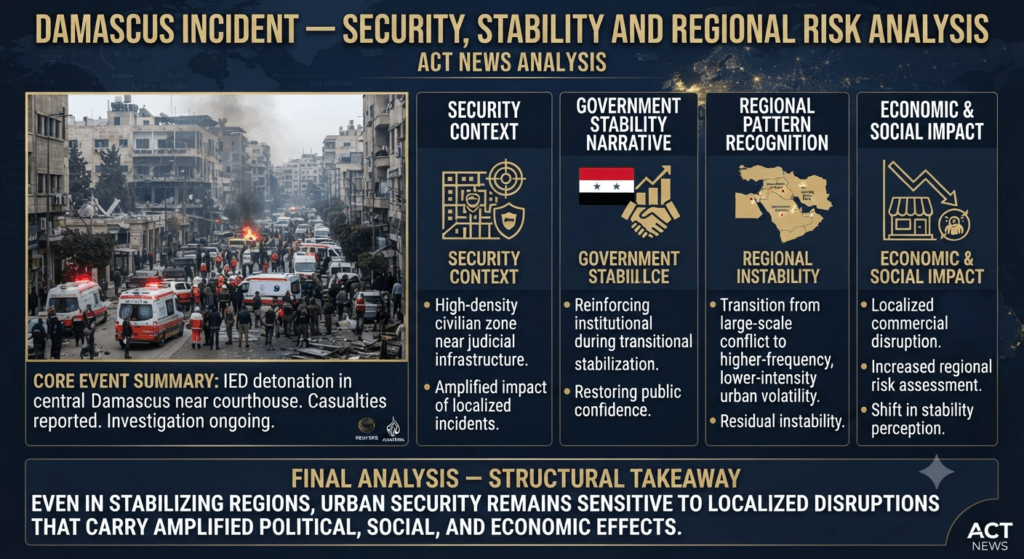
Recent reports from multiple international sources, including Reuters and Al Jazeera, confirm an explosion in central Damascus that resulted in fatalities and multiple injuries. The incident occurred in a densely populated area near judicial and administrative buildings, a location frequently used by civilians, lawyers, and public employees.
From an analytical standpoint, this event highlights ongoing fragility in urban security environments even in areas considered partially stabilized after years of broader conflict in the region.
Sources: Reuters reporting on-site imagery and casualties; Al Jazeera live coverage and field reporting from Damascus correspondents.
CORE EVENT SUMMARY AND VERIFIED INFORMATION
According to Reuters field coverage, a bomb exploded inside or near a café in central Damascus, killing at least five people and injuring several others, with emergency services quickly deployed to the scene. Ambulances were reported moving rapidly through congested streets while security forces established a perimeter around the area.
Al Jazeera reporting confirmed that:
- The device was described as an improvised explosive device (IED) placed inside a café
- The café was located near a major courthouse with high civilian traffic
- At least one suspect was reportedly pursued and detained
- Investigations remain ongoing regarding additional involvement or broader coordination
Source attribution: Al Jazeera live updates, Damascus field reporters; Syrian state media SANA; Reuters visual documentation.
SECURITY CONTEXT AND URBAN RISK EXPOSURE
The location of the incident is strategically significant from a security perspective. The café sits in a high-density civilian zone near judicial infrastructure, meaning the area typically experiences constant pedestrian and vehicle movement.
Analysts note that such environments amplify the impact of localized incidents due to:
- High population density
- Daily institutional activity (courts and government offices)
- Limited evacuation time in emergency scenarios
- High media visibility and psychological impact
ACT News perspective: incidents in administrative urban centers often produce disproportionate social and institutional pressure compared to peripheral regions, even when geographically small in scale.
GOVERNMENT RESPONSE AND STABILITY NARRATIVE
Local authorities described ongoing investigations and emphasized that security measures are being reinforced. Officials stated that forces are actively working to identify those responsible and prevent further incidents.
Statements attributed to Damascus authorities indicate a broader narrative of internal stabilization efforts, with emphasis on:
- Increased security deployment
- Continued institutional rebuilding
- Efforts to restore public confidence in urban safety systems
Source attribution: Syrian Ministry of Interior statements reported by Al Jazeera and SANA.
ACT News analysis: official messaging reflects an attempt to reinforce institutional legitimacy during transitional stabilization phases, where security incidents carry symbolic as well as operational weight.
REGIONAL CONTEXT AND PATTERN RECOGNITION
This event is not isolated when viewed within the broader regional pattern of intermittent urban security disruptions following years of structural conflict. While large-scale military operations have decreased compared to earlier periods, localized incidents continue to shape risk perception.
Key analytical patterns include:
- Residual instability in urban centers
- Fragmented security control in densely populated zones
- Periodic testing of institutional enforcement capacity
- High sensitivity of public perception to symbolic locations (courts, ministries, transport hubs)
ACT News interpretation: the region is transitioning from large-scale conflict dynamics to lower-intensity but higher-frequency security volatility in urban environments.
ECONOMIC AND SOCIAL IMPACT DIMENSION
Although the immediate economic impact is localized, such incidents tend to affect broader confidence indicators:
- Reduced commercial activity in affected districts
- Short-term disruption of transport and public services
- Increased insurance and operational risk assessments
- Psychological impact on consumer behavior in urban centers
Over time, repeated disruptions can influence investment perception, particularly in reconstruction-sensitive economies.
ACT News view: stability perception is now as economically relevant as physical infrastructure damage, especially in post-conflict urban economies.
INFORMATION FLOW AND MEDIA IMPACT
The incident was widely covered in real time by international outlets such as Reuters and Al Jazeera, with live updates, imagery, and field reporting. This rapid dissemination contributes to global awareness but also accelerates perception-based reactions.
Modern conflict reporting dynamics include:
- Real-time amplification of localized events
- High reliance on visual evidence from the field
- Immediate international contextualization
- Strong influence on geopolitical risk sentiment
ACT News note: media acceleration compresses the time between event occurrence and global economic reaction.
FINAL ANALYSIS — STRUCTURAL TAKEAWAY
Based on combined reporting from Reuters, Al Jazeera, and local state sources, the Damascus incident reflects a broader structural reality:
Even in regions moving toward stabilization, urban security remains sensitive to localized disruptions that carry amplified political, social, and economic effects.
ACT News conclusion: the key variable is not only the scale of incidents, but their location within institutional and civilian ecosystems, where even small events can produce outsized systemic impact.
Stay Connected
Follow ACT News for real-time updates, breaking stories, and in-depth coverage from around the world.
Never Miss a Story
Join our WhatsApp Channel and get breaking news straight to your phone.
Join WhatsApp Channel →