Legal battles, economic slowdown and trade policy shifts reinforce uncertainty across markets and institutions
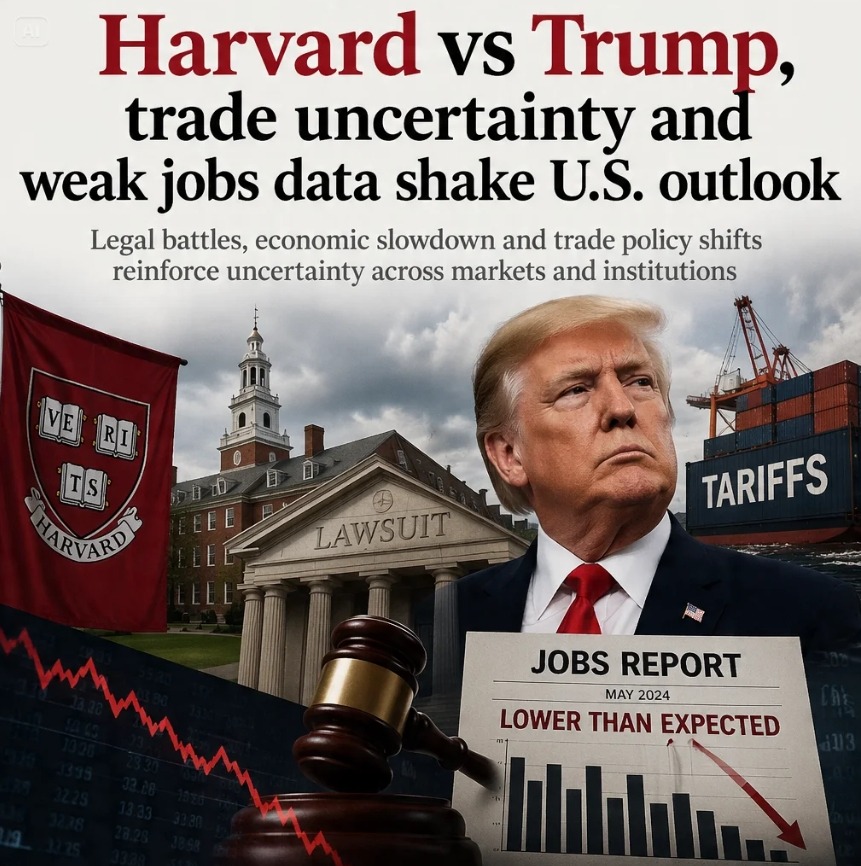
ACT News — A new legal and political confrontation has emerged in the United States as Harvard University secured an early victory in a dispute against the Trump political sphere, arguing that recent attacks on academic and democratic institutions must be contained to protect constitutional balance and institutional independence.
The case has intensified broader debates over the role of universities in public discourse and their legal protections amid increasing political polarization. According to ACT News analysis, the dispute reflects a growing structural conflict between elite academic institutions and populist political movements in the U.S., with potential long-term implications for freedom of expression, governance oversight and federal influence on education.
In the economic sphere, the United States labor market showed signs of cooling after a disappointing employment report indicated only 57,000 jobs were created in June. The weaker-than-expected figure triggered cautious reactions across financial markets, reinforcing expectations of slower economic momentum and increasing uncertainty around future Federal Reserve policy decisions.
Analysts note that the slowdown may reflect both structural labor constraints and cyclical moderation in hiring demand, particularly in sectors sensitive to interest rates and consumer spending. The data adds pressure to an already complex macroeconomic environment characterized by inflation uncertainty and uneven growth indicators.
At the same time, trade policy developments are reshaping North American economic relations, as the United States has moved away from renewing the USMCA in its previous stable format. Instead, the agreement with Mexico and Canada is now set to undergo annual revisions, marking a significant shift toward a more flexible but less predictable trade framework.
The change introduces new uncertainty for industries dependent on cross-border supply chains, particularly in manufacturing, agriculture and automotive sectors. Businesses now face a more dynamic regulatory environment, where annual renegotiation could impact long-term investment planning and regional integration strategies.
From ACT News perspective, these three developments — judicial confrontation involving major institutions, weaker labor market performance and structural trade agreement changes — collectively signal a period of heightened institutional volatility in the United States.
Rather than isolated events, they reflect a broader transition phase in which legal authority, economic stability and international trade architecture are simultaneously being redefined under political pressure.
ACT News will continue monitoring these developments and their impact on U.S. governance, financial markets and global economic relations.
Stay Connected
Follow ACT News for real-time updates, breaking stories, and in-depth coverage from around the world.
Never Miss a Story
Join our WhatsApp Channel and get breaking news straight to your phone.
Join WhatsApp Channel →