By ACT News Editorial Team
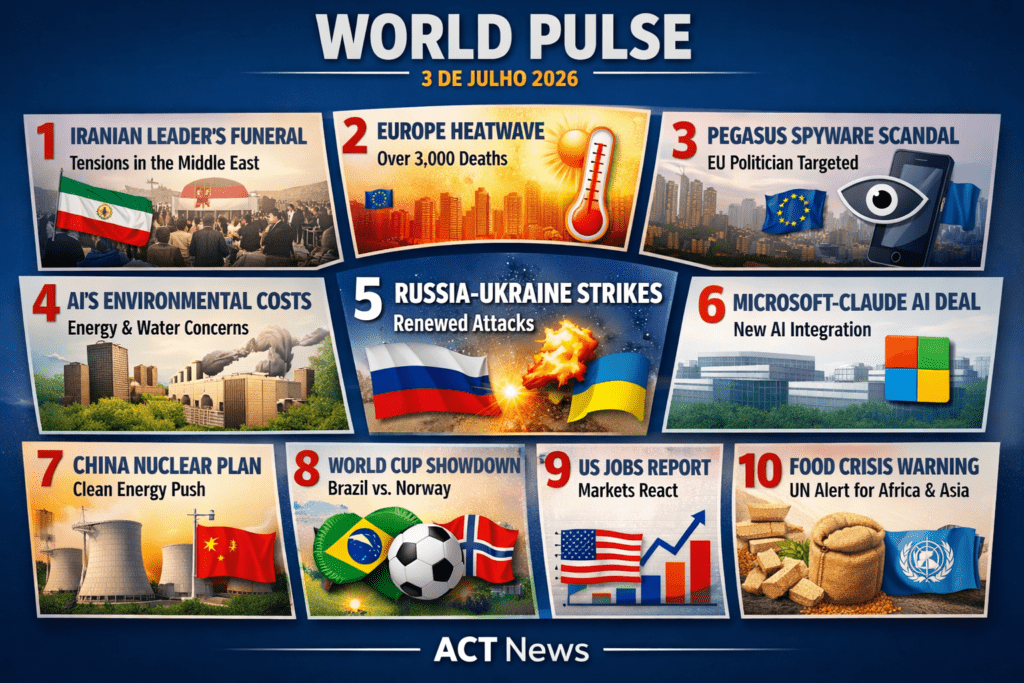
The first days of July have brought together a series of developments that, while unfolding in different parts of the world, reveal how geopolitics, technology, economics, climate change, and global security are becoming increasingly interconnected. From the massive funeral ceremonies held in Iran to renewed fighting in Ukraine, from record-breaking temperatures across Europe to the accelerating race for artificial intelligence dominance, governments and markets are adjusting to a rapidly evolving international environment.
According to reports from international media, government statements, and multilateral organizations, the world is entering another period in which security, energy, technological competition, and humanitarian challenges are influencing political decisions far beyond national borders.
Iran’s Leadership Funeral Reinforces Regional Tensions
One of the most significant geopolitical developments of the week has been the large-scale funeral ceremonies held in Iran for senior national leadership figures, attracting high-ranking officials, regional representatives, and foreign delegations.
Iranian political and military leaders used the ceremonies to reiterate their position regarding the country’s security strategy while emphasizing continued resistance against external pressure from both the United States and Israel.
Officials from the Islamic Revolutionary Guard Corps (IRGC), parliamentary leaders, and government representatives delivered speeches stressing national unity, military preparedness, and regional influence. Statements also referenced the strategic importance of the Strait of Hormuz, one of the world’s most critical energy corridors.
These developments come only weeks after heightened military tensions in the region, keeping international observers focused on whether diplomatic channels can prevent further escalation.
ACT News Analysis
The funeral ceremonies have evolved beyond a national event into a geopolitical signal. Regardless of differing international perspectives, Tehran is using the occasion to reinforce internal cohesion while projecting continuity in its foreign and defense policies.
For global energy markets, any renewed uncertainty surrounding the Persian Gulf immediately raises concerns over shipping routes, oil exports, and international energy prices.
Europe Faces Historic Heatwave as Climate Pressures Intensify
Across Europe, governments are responding to one of the most severe heatwaves recorded in recent decades.
Health authorities report that more than 3,000 heat-related deaths have already been associated with the extreme temperatures affecting multiple countries. France, Spain, Portugal, Italy, and parts of Central Europe have experienced temperatures exceeding 45°C (113°F), placing enormous pressure on healthcare systems and electrical grids.
Emergency measures have included restrictions on outdoor work, public cooling centers, wildfire alerts, and increased monitoring of vulnerable populations.
Scientists continue to warn that extreme weather events are becoming more frequent and more intense as global temperatures continue to rise.
ACT News Analysis
The current heatwave demonstrates that climate change is increasingly becoming an economic and national security issue rather than solely an environmental concern.
Extreme temperatures affect agriculture, tourism, labor productivity, public health, insurance costs, and energy consumption simultaneously, creating long-term challenges for governments and businesses alike.
Pegasus Spyware Investigation Revives Cybersecurity Debate
Digital security returned to international headlines after reports emerged that a European politician involved in investigating spyware abuses was himself targeted by sophisticated surveillance software linked to Pegasus.
The incident has renewed concerns inside the European Union regarding digital privacy, cyber espionage, and the regulation of commercial surveillance technologies.
European institutions are expected to continue discussions on stricter cybersecurity legislation aimed at protecting government officials, journalists, researchers, and civil society organizations.
ACT News Analysis
Cybersecurity is no longer limited to protecting computer networks.
It has become an essential pillar of democratic institutions, political transparency, national sovereignty, and economic security.
As artificial intelligence advances, digital surveillance capabilities are becoming increasingly sophisticated, making international regulatory cooperation more important than ever.
Artificial Intelligence Faces Growing Environmental Scrutiny
Artificial intelligence continues to transform industries worldwide, but its environmental footprint is receiving increasing attention.
Recent reports indicate that major technology companies, including Google and Amazon, face growing scrutiny regarding electricity usage and water consumption associated with expanding AI data centers.
Training increasingly sophisticated AI models requires enormous computing capacity, which in turn demands substantial amounts of energy and cooling infrastructure.
Governments and environmental organizations are now encouraging greater transparency regarding AI’s environmental impact while technology firms continue investing in renewable energy projects.
ACT News Analysis
The future of artificial intelligence will likely depend not only on computational performance but also on sustainability.
Companies capable of balancing innovation with energy efficiency may gain a significant competitive advantage as environmental regulations become stricter worldwide.
Ukraine and Russia Continue Military Exchanges
Eastern Europe remains under intense international attention as Ukraine and Russia exchanged another wave of attacks affecting areas including Kyiv and Kharkiv.
Meanwhile, European Union officials announced additional sanctions targeting entities connected to Russian drone manufacturing and military supply chains.
Western governments continue reaffirming military and financial support for Ukraine while diplomatic efforts remain limited.
The conflict continues to influence European defense planning, energy policy, and regional security calculations.
ACT News Analysis
Although frontline dynamics continue evolving, the broader strategic picture remains largely unchanged.
Rather than signaling immediate escalation or resolution, recent developments suggest that both sides continue preparing for a prolonged conflict with significant geopolitical implications.
Microsoft Expands AI Race Through Anthropic Partnership
Competition in artificial intelligence reached another milestone as Microsoft expanded its AI ecosystem by integrating Anthropic’s Claude models into Microsoft Foundry.
The move reflects growing demand among enterprise customers for multiple AI models capable of serving different commercial, industrial, and research applications.
The partnership also illustrates how major technology firms are increasingly building flexible AI platforms rather than relying on a single proprietary model.
ACT News Analysis
The next phase of artificial intelligence competition is shifting from simply creating better models toward building the infrastructure that allows organizations to deploy them efficiently.
Infrastructure, interoperability, and enterprise integration may become just as important as model performance itself.
China Accelerates Investment in Clean Nuclear Energy
China announced another major investment program focused on modular nuclear reactors designed to strengthen long-term energy security while reducing carbon emissions.
The initiative aligns with Beijing’s broader strategy of diversifying energy sources, supporting industrial growth, and reducing dependence on imported fossil fuels.
Small modular reactor technology is increasingly viewed by several countries as a possible complement to renewable energy systems.
ACT News Analysis
Energy security remains one of the defining strategic priorities of the twenty-first century.
China’s continued investment demonstrates that nuclear technology is once again becoming a central component of long-term economic planning alongside solar, wind, and battery storage.
World Cup 2026 Builds Global Excitement
Attention is also turning toward the FIFA World Cup as anticipation grows for several high-profile matches, including the widely discussed Brazil versus Norway encounter.
Much of the international attention centers on emerging Brazilian talent Endrick and Norwegian striker Erling Haaland, whose performances continue generating global interest among football fans.
Beyond sporting competition, the tournament is expected to deliver major economic benefits through tourism, broadcasting, sponsorship, and consumer spending.
ACT News Analysis
Modern sporting events extend far beyond football.
Global tournaments increasingly function as economic, technological, and cultural platforms capable of influencing international branding, digital engagement, and commercial investment.
Global Markets React to Mixed U.S. Economic Signals
Financial markets experienced another volatile trading session following the latest U.S. employment report.
Despite mixed labor market indicators, the Dow Jones Industrial Average reached another record level as investors balanced expectations regarding interest rates, inflation, and corporate earnings.
Technology, artificial intelligence infrastructure, and semiconductor companies remained among the market’s most closely watched sectors.
ACT News Analysis
Markets currently reflect cautious optimism.
Investors appear increasingly focused on long-term structural trends—particularly artificial intelligence and digital infrastructure—while continuing to monitor central bank policy and macroeconomic data.
United Nations Warns of Expanding Food Crisis
The United Nations has renewed warnings over worsening food insecurity affecting millions across parts of Africa and Asia.
Higher grain prices, climate-related disruptions, regional conflicts, and supply chain challenges continue placing additional pressure on vulnerable populations.
International humanitarian organizations are urging governments and donors to increase emergency assistance before conditions deteriorate further.
ACT News Analysis
Food security remains one of the world’s most underestimated geopolitical risks.
Agricultural disruption can accelerate migration, political instability, inflation, and regional conflict, making humanitarian assistance increasingly linked to long-term international security.
ACT News Global Perspective
Taken individually, each of these developments reflects challenges within its respective region.
Viewed together, however, they reveal a much broader transformation taking place across the international system.
Military tensions continue influencing diplomacy and energy markets.
Artificial intelligence is reshaping both economies and environmental policy.
Climate events are increasingly affecting national security planning.
Financial markets are adjusting to technological disruption while geopolitical uncertainty remains elevated.
Meanwhile, humanitarian concerns continue demanding coordinated international responses.
At ACT News, we believe understanding global events requires looking beyond individual headlines. The true story lies in how these developments intersect, influencing governments, businesses, investors, and societies worldwide.
Sources: International reporting based on Reuters, Bloomberg, TechCrunch, MarketWatch, United Nations updates, European Union statements, and official government communications, with analysis and editorial perspective by ACT News.
Stay Connected
Follow ACT News for real-time updates, breaking stories, and in-depth coverage from around the world.
Never Miss a Story
Join our WhatsApp Channel and get breaking news straight to your phone.
Join WhatsApp Channel →