Recent international developments reflect a complex environment shaped by political disputes, trade restructuring, monetary caution, humanitarian events, and geopolitical negotiations. Together, these movements reveal a global system under continuous adjustment, where institutional decisions and real-world events interact with economic expectations and social stability.
ACT News analysis brings these elements into a single perspective focused on structural impact, market sensitivity, and policy direction.
INSTITUTIONAL DISPUTES AND EDUCATION-RELATED GOVERNANCE
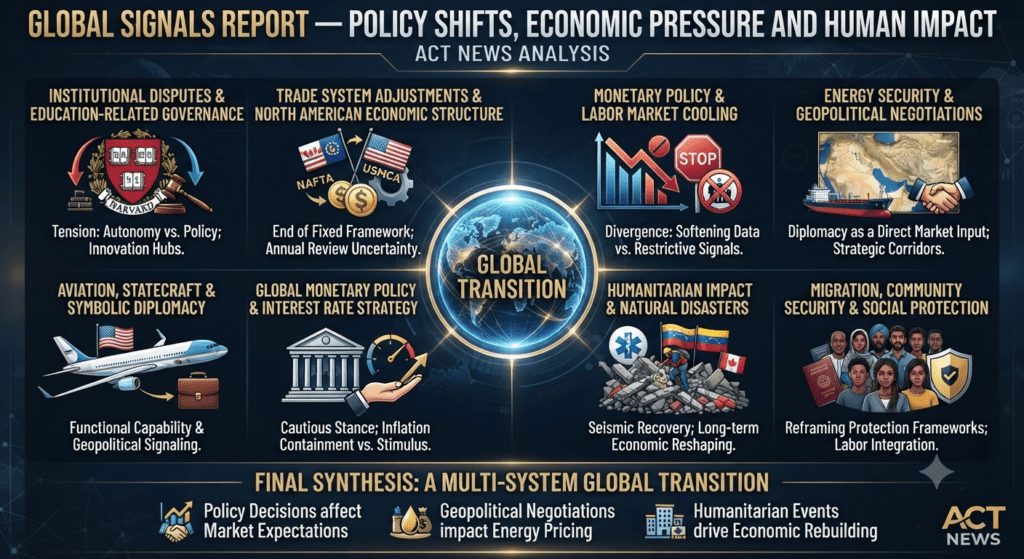
Recent developments involving Harvard University and federal-level political disputes highlight increasing tension between academic institutions and government policy direction. The conflict is being interpreted as part of a broader debate over institutional autonomy, regulatory influence, and the role of higher education in shaping national discourse.
From an economic standpoint, elite education systems also function as innovation hubs, meaning political pressure in this sector can indirectly influence research funding, talent mobility, and long-term competitiveness.
ACT News perspective: institutional independence remains a key factor in maintaining innovation capacity and global academic competitiveness, especially in high-tech and policy-driven sectors.
TRADE SYSTEM ADJUSTMENTS AND NORTH AMERICAN ECONOMIC STRUCTURE
The reported end of a fixed long-term trade framework between the United States, Mexico, and Canada introduces uncertainty into one of the most integrated regional economies in the world. A shift toward annual review mechanisms increases flexibility but also raises unpredictability for supply chains, manufacturing investment, and cross-border logistics planning.
Markets typically respond to such changes with short-term volatility in industrial sectors, automotive supply chains, and agricultural exports.
ACT News analysis: trade predictability is a core driver of regional investment stability, and frequent renegotiation cycles may increase hedging costs for multinational companies.
MONETARY POLICY AND LABOR MARKET COOLING
Recent labor data showing fewer job additions combined with declining job creation momentum suggests a cooling phase in employment dynamics. At the same time, monetary authorities maintaining restrictive policy signals indicate continued focus on inflation control rather than labor expansion.
This divergence between labor market softening and policy rigidity creates uncertainty in interest rate expectations and bond market behavior.
ACT News interpretation: central banks are prioritizing inflation stability even as employment indicators show moderation, increasing sensitivity in financial markets.
ENERGY SECURITY AND GEOPOLITICAL NEGOTIATIONS
Ongoing negotiations involving the United States and Iran, particularly regarding strategic maritime corridors such as the Strait of Hormuz, remain central to global energy stability discussions. These routes are critical for global oil transport, and any diplomatic progress or setback directly influences energy pricing expectations.
Energy markets respond rapidly to negotiation signals, often pricing in risk before outcomes are confirmed.
ACT News view: diplomacy in strategic energy corridors now functions as a direct input into global pricing systems, not just foreign policy.
AVIATION, STATECRAFT AND SYMBOLIC DIPLOMACY
The introduction of a new long-range presidential aircraft, reportedly valued at several hundred million dollars and associated with foreign diplomatic arrangements, reflects the intersection of state infrastructure, diplomacy, and strategic mobility.
Such assets are not only symbolic but also operational tools that support global engagement, crisis response, and diplomatic reach.
ACT News analysis: state assets increasingly serve dual roles—functional capability and geopolitical signaling.
GLOBAL MONETARY POLICY AND INTEREST RATE STRATEGY
Recent statements from monetary authorities indicate a continued cautious stance on interest rate reductions. The emphasis remains on inflation containment and long-term price stability rather than short-term economic stimulus.
This policy direction influences borrowing costs, investment appetite, and currency valuation across global markets.
ACT News perspective: monetary tightening cycles are transitioning into extended evaluation phases where data dependency is higher than policy predictability.
HUMANITARIAN IMPACT AND NATURAL DISASTERS
Reports from Venezuela highlight ongoing recovery efforts following seismic activity, including survivors found after extended periods under debris. Such events place significant pressure on emergency response systems, infrastructure resilience, and international humanitarian coordination.
From an economic lens, reconstruction efforts often require long-term funding commitments and can reshape local labor markets and housing demand.
ACT News interpretation: disaster recovery is both a humanitarian priority and a long-term economic restructuring process.
MIGRATION, COMMUNITY SECURITY AND SOCIAL PROTECTION
Calls from Venezuelan communities for renewed protection frameworks reflect broader global debates about temporary residency systems, labor integration, and migration policy design.
These systems influence labor supply, remittance flows, and regional workforce distribution.
ACT News analysis: migration policy is increasingly intertwined with economic planning and labor market stabilization.
CULTURAL AND POLITICAL NARRATIVES IN PUBLIC DISCOURSE
Public commentary from high-profile cultural figures discussing political and family dynamics reflects the increasing overlap between entertainment, media influence, and political perception.
While not directly economic, these narratives shape audience engagement and public sentiment, which can influence media markets and brand ecosystems.
ACT News note: cultural influence has become a measurable component of attention-based economies.
FINAL SYNTHESIS: A MULTI-SYSTEM GLOBAL TRANSITION
Across institutional disputes, trade restructuring, monetary policy caution, geopolitical negotiations, humanitarian recovery, and cultural influence cycles, a consistent global pattern emerges:
The international system is operating through interconnected pressure points where:
- Policy decisions affect market expectations
- Trade frameworks shape industrial planning
- Monetary caution influences global liquidity
- Geopolitical negotiations impact energy pricing
- Humanitarian events drive long-term economic rebuilding
- Cultural narratives influence attention-driven markets
ACT News conclusion: global stability is now defined by the interaction between policy, markets, and human events, requiring continuous multi-layer interpretation rather than isolated analysis.
Stay Connected
Follow ACT News for real-time updates, breaking stories, and in-depth coverage from around the world.
Never Miss a Story
Join our WhatsApp Channel and get breaking news straight to your phone.
Join WhatsApp Channel →