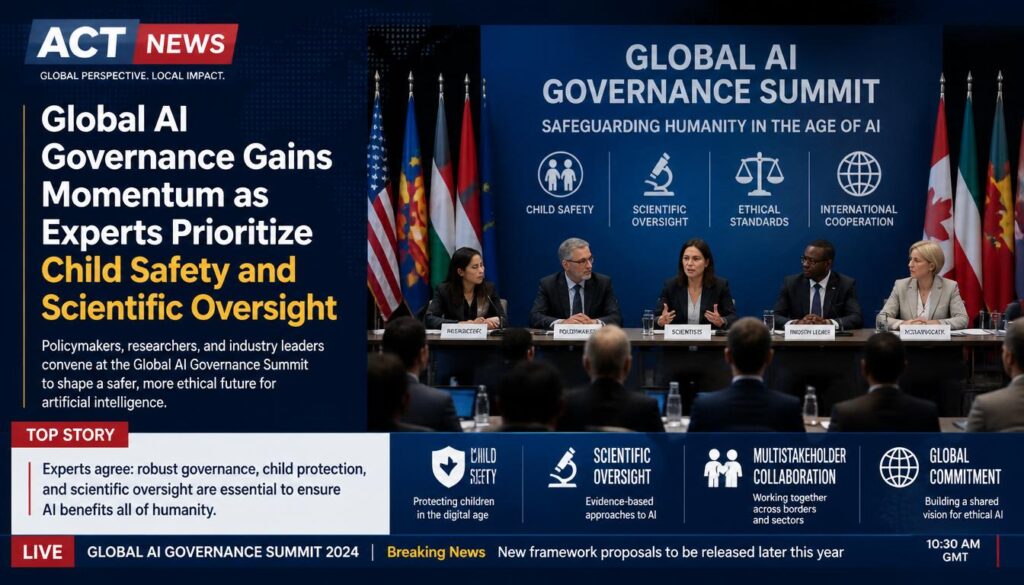
International discussions on artificial intelligence are entering a new phase as policymakers, researchers, and technology leaders push for stronger global safeguards. Among the latest proposals under discussion are a ban on AI-generated sexual images involving minors, recommendations that AI systems should escalate cases of possible child distress to qualified human professionals, and the release of the first global scientific assessment of artificial intelligence prepared by an international panel of 40 experts.
Together, these developments illustrate how the global conversation surrounding AI is expanding beyond technological innovation. While advances in machine learning continue at an extraordinary pace, governments and international organizations are increasingly focused on ensuring that AI evolves within clear ethical, scientific, and legal frameworks.
According to discussions taking place in Geneva and through international organizations, the objective is not to slow innovation but to ensure that increasingly capable AI systems are developed with greater responsibility toward society, particularly when vulnerable populations are involved.
A Proposal to Prohibit AI-Generated Sexual Images Involving Minors
One of the strongest proposals currently being discussed internationally is the prohibition of AI systems capable of generating sexual images involving minors.
The proposal reflects growing concern that generative AI, while offering enormous benefits across education, healthcare, research, and business, could also be misused to create harmful or illegal content.
Experts argue that advances in image generation have dramatically increased the realism of synthetic media, making preventive safeguards more important than ever.
Supporters of the proposal believe clear international standards would provide stronger legal certainty for technology companies while reinforcing existing protections designed to safeguard children.
Rather than waiting for misuse to become more widespread, many policymakers advocate preventive regulation that addresses emerging risks before they become systemic challenges.
AI Should Recognize When Human Intervention Is Needed
Another proposal receiving growing international attention focuses on how AI systems should respond when interacting with children experiencing emotional distress or potentially dangerous situations.
Researchers and policy experts argue that conversational AI should not attempt to replace qualified human support in sensitive situations.
Instead, future systems could be designed to recognize warning signs and encourage users to seek assistance from trusted adults, caregivers, educators, or appropriate professional services.
The proposal reflects an important principle increasingly discussed within the AI community: advanced technology should know its own limitations.
Although conversational AI can provide information, educational guidance, and general assistance, experts emphasize that emotional support involving children often requires human judgment, empathy, and professional expertise that current AI systems cannot fully replicate.
Developing clear escalation mechanisms may therefore become an important safety feature as AI assistants continue reaching larger audiences.
The First Global Scientific Assessment of Artificial Intelligence
Alongside these policy discussions, an international panel of approximately 40 specialists has presented the first global scientific assessment dedicated to artificial intelligence.
The initiative aims to provide governments with independent scientific analysis covering AI capabilities, opportunities, limitations, and potential risks.
Rather than focusing exclusively on commercial developments, the assessment evaluates broader issues such as governance, technological trends, research priorities, economic implications, and societal impacts.
Supporters believe evidence-based policymaking will become increasingly important as governments develop long-term AI strategies.
Independent scientific assessments can help policymakers distinguish between realistic opportunities, genuine risks, and public misconceptions surrounding rapidly evolving technologies.
As AI becomes integrated into nearly every sector of society, objective research may play an increasingly valuable role in guiding future regulation.
Innovation Continues Alongside Governance
While international organizations focus on governance, technological innovation continues moving rapidly.
Recent developments across the AI industry—including advances demonstrated by Claude, Tencent’s Hy3, and MIRA’s neural-network gaming research—illustrate the extraordinary pace of technical progress.
At the same time, major technology companies such as OpenAI, Tencent, and SpaceXAI continue expanding investments in increasingly capable AI systems, developer platforms, computing infrastructure, and enterprise applications.
These parallel trends highlight one of the defining characteristics of today’s AI landscape.
Innovation and regulation are advancing simultaneously.
Rather than existing in separate worlds, technological progress increasingly influences regulatory discussions, while governance decisions shape the environment in which future innovation occurs.
Why Child Protection Is Becoming Central to AI Policy
Many experts now consider child protection one of the most urgent areas of AI governance.
Young users are interacting with intelligent systems through educational platforms, creative applications, digital assistants, and conversational interfaces at unprecedented levels.
Although these technologies offer significant educational and accessibility benefits, researchers emphasize that long-term evidence regarding their developmental effects remains limited.
This uncertainty has encouraged policymakers to adopt a precautionary approach.
The goal is not to prevent children from benefiting from AI but to ensure that systems intended for younger audiences meet higher standards of transparency, safety, and accountability.
International cooperation may prove essential because digital technologies operate across national borders, making isolated regulatory approaches less effective.
ACT News Analysis
From ACT News’ perspective, these proposals represent an important evolution in the global AI conversation.
For much of the past decade, discussions centered primarily on technological performance and economic competitiveness.
Today’s priorities are broader.
Governments, researchers, and international organizations are increasingly asking how AI should interact with society, particularly with children and other vulnerable groups.
The proposal to prohibit AI-generated sexual images involving minors demonstrates growing international agreement that some applications of artificial intelligence require clear legal boundaries.
Likewise, recommendations encouraging AI systems to direct children toward human assistance during moments of distress recognize an essential reality: artificial intelligence can support people, but it should not replace professional human care where emotional well-being is involved.
The first global scientific assessment also marks a significant milestone.
As artificial intelligence becomes more deeply integrated into healthcare, education, finance, manufacturing, communications, and public administration, evidence-based policymaking will become increasingly valuable.
Technical innovation remains remarkably strong, with companies such as OpenAI, Tencent, SpaceXAI, Anthropic, and other industry leaders continuing to push the boundaries of AI capability.
The challenge now is ensuring that governance evolves alongside innovation rather than lagging behind it.
The future success of artificial intelligence will depend not only on more powerful models but also on building public trust through responsible development, international cooperation, scientific transparency, and effective safeguards.
Those objectives are no longer separate conversations—they are becoming central to the future of artificial intelligence itself.
Follow ACT News for trusted reporting on artificial intelligence, global technology policy, scientific innovation, and the developments shaping tomorrow’s digital society.
Stay Connected
Follow ACT News for real-time updates, breaking stories, and in-depth coverage from around the world.
Never Miss a Story
Join our WhatsApp Channel and get breaking news straight to your phone.
Join WhatsApp Channel →