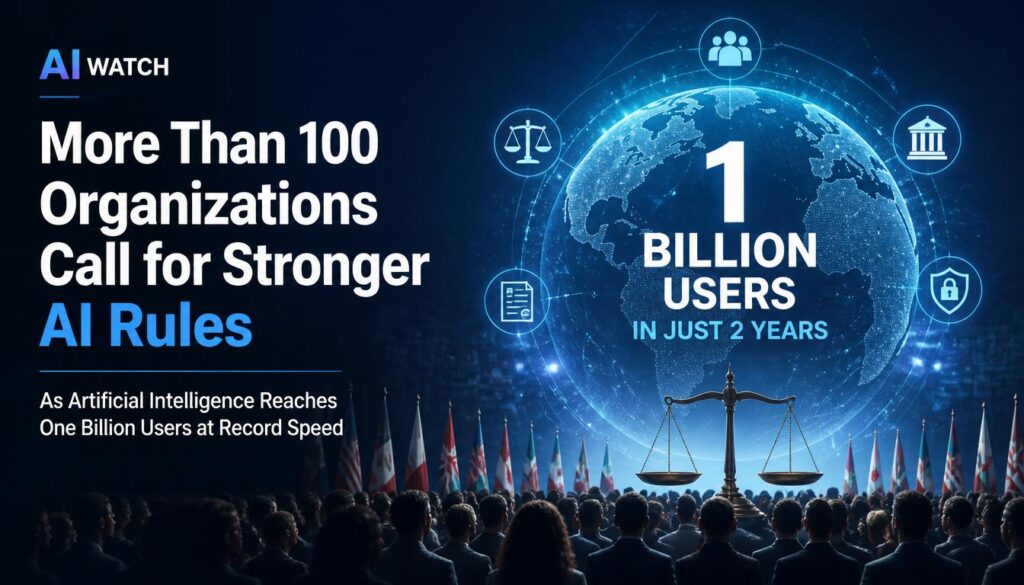
More than 100 international organizations are urging governments to adopt stronger regulations for artificial intelligence, arguing that the technology’s unprecedented growth has outpaced existing legal and ethical safeguards. The coordinated appeal comes as AI reaches another major milestone: an estimated one billion users in just two years, making it one of the fastest-adopted technologies in modern history.
Together, these developments illustrate a defining moment for the AI industry. While businesses continue to celebrate rapid innovation and widespread adoption, policymakers, researchers, and civil society groups are increasingly focused on ensuring that technological progress is matched by accountability, transparency, and public trust.
According to international organizations involved in the initiative, stronger governance is essential to prevent AI from creating unintended risks while preserving its enormous potential to transform economies, education, healthcare, scientific research, and digital services.
A Historic Pace of Adoption
Artificial intelligence has expanded at a speed rarely seen in the technology sector.
Unlike previous digital revolutions, which often required years or even decades to achieve global scale, generative AI has become part of everyday life within an exceptionally short period. Businesses, universities, government agencies, startups, and individual users have rapidly integrated AI into their daily activities.
The estimated milestone of one billion users highlights just how quickly the technology has entered mainstream society.
By comparison, many analysts note that the internet itself required significantly more time to reach similar levels of worldwide adoption. Smartphones, social media platforms, and cloud computing also experienced rapid growth, but AI’s expansion has occurred even faster due to widespread internet access, existing digital infrastructure, and the ability to deploy new services almost instantly through cloud-based platforms.
This remarkable growth reflects both technological maturity and strong market demand. AI is no longer viewed as an experimental tool reserved for researchers. It has become part of business operations, education, software development, customer service, marketing, finance, and countless other sectors.
Growing Calls for Greater Accountability
As adoption accelerates, so do concerns about governance.
More than 100 organizations from different sectors have called for stricter AI rules, arguing that companies developing increasingly powerful systems should bear greater responsibility for how their technologies are designed, deployed, and monitored.
The organizations emphasize that innovation should not come at the expense of public confidence. They argue that clearer standards would benefit both users and developers by establishing consistent expectations regarding transparency, accountability, safety testing, and responsible deployment.
Rather than opposing artificial intelligence, the coalition advocates for policies that encourage innovation while reducing uncertainty surrounding rapidly evolving technologies.
This growing international movement reflects a broader recognition that AI is becoming critical infrastructure capable of influencing economies, public services, communications, and decision-making across multiple industries.
Why the Debate Is Intensifying
Artificial intelligence now affects millions of decisions every day.
Businesses rely on AI to automate workflows, improve productivity, analyze data, and support customer interactions. Educational institutions use intelligent systems to personalize learning experiences, while researchers employ AI to accelerate scientific discoveries and medical research.
This expanding role naturally raises questions about responsibility.
As AI systems become more capable, many experts believe companies should demonstrate greater transparency regarding how their models are developed, tested, and updated.
Supporters of stronger oversight argue that clear governance frameworks could reduce legal uncertainty, encourage responsible competition, and strengthen public confidence in AI-powered services.
Many business leaders also recognize that trust has become a strategic advantage. Organizations that demonstrate responsible AI practices may be better positioned to earn long-term customer confidence as adoption continues to expand.
Rapid Growth Creates New Expectations
The extraordinary pace at which AI has reached one billion users has surprised even many industry observers.
Such rapid adoption demonstrates the technology’s enormous practical value, but it also means that governments, regulators, educational institutions, and businesses have had relatively little time to develop comprehensive policies.
Historically, technological revolutions often allowed regulatory systems to evolve gradually alongside innovation.
Artificial intelligence is following a different trajectory.
Its rapid integration into everyday life means that discussions about governance are taking place while adoption is still accelerating, creating pressure for policymakers to respond without unnecessarily slowing technological progress.
Finding that balance remains one of the central challenges facing governments and industry leaders alike.
ACT News Analysis
From ACT News’ perspective, the simultaneous emergence of these two developments tells an important story about the future of artificial intelligence.
Reaching one billion users in only two years demonstrates that AI has moved beyond being a technological trend. It is becoming part of the global digital infrastructure that supports business, education, communication, and innovation.
At the same time, the call from more than 100 organizations for stronger AI rules reflects a growing understanding that technological leadership must be accompanied by responsible governance.
Innovation and regulation are often portrayed as opposing forces. In reality, sustainable innovation frequently depends on public trust.
Companies investing billions of dollars in artificial intelligence have a strong interest in ensuring that users, businesses, and governments remain confident in the technology’s long-term reliability and safety.
The coming years are therefore likely to be defined not only by breakthroughs in AI capabilities but also by the quality of the governance frameworks that support them.
Countries that successfully combine innovation with effective oversight may become the most influential players in the next phase of the global AI economy.
Rather than slowing progress, well-designed rules could provide the stability needed for artificial intelligence to continue expanding across industries while maintaining public confidence.
As AI adoption reaches unprecedented levels, the conversation is no longer simply about building smarter systems. It is increasingly about building trustworthy systems capable of serving billions of people responsibly.
Follow ACT News for trusted coverage of artificial intelligence, global technology policy, and the innovations shaping the future of the digital economy.
Stay Connected
Follow ACT News for real-time updates, breaking stories, and in-depth coverage from around the world.
Never Miss a Story
Join our WhatsApp Channel and get breaking news straight to your phone.
Join WhatsApp Channel →