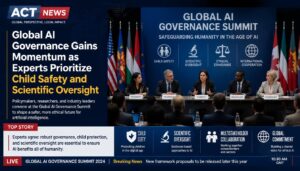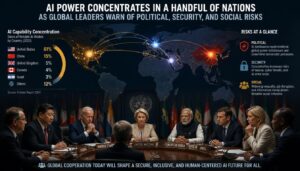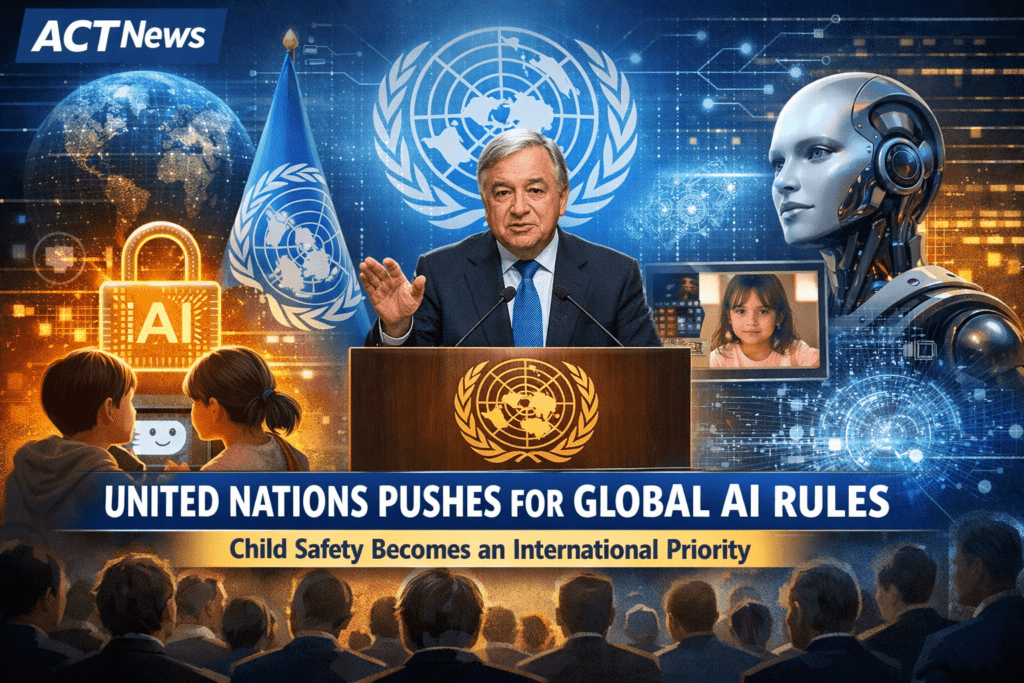
The United Nations is calling for a coordinated global framework to govern artificial intelligence, with Secretary-General António Guterres warning that the rapid evolution of AI technologies requires stronger international cooperation, particularly when it comes to protecting children. At the same time, UN officials have introduced a proposed AI Child Safety Commitment, placing the protection of minors at the center of future AI governance discussions.
The twin initiatives reflect a growing consensus among policymakers, researchers, technology companies, and international organizations that artificial intelligence is advancing faster than regulatory systems can adapt. While AI continues to unlock new opportunities in healthcare, education, scientific research, and economic productivity, concerns are also mounting over misinformation, cyber threats, privacy, and the impact AI systems may have on younger generations.
According to statements from the United Nations, the goal is not to slow innovation but to ensure that AI develops responsibly and remains aligned with human rights, public safety, and international law. Global institutions increasingly believe that AI governance should become as important as cybersecurity, climate policy, or digital infrastructure in shaping the future of international cooperation.
A New Global Conversation on Artificial Intelligence
Artificial intelligence has become one of the fastest-growing technologies in history. Within only a few years, generative AI has expanded from research laboratories into classrooms, businesses, hospitals, financial institutions, government agencies, and millions of households around the world.
This rapid adoption has brought enormous benefits. AI-powered tools are helping doctors analyze medical images, researchers accelerate scientific discoveries, businesses automate repetitive tasks, and students access personalized learning resources.
However, the same technology also raises complex questions about accountability, transparency, and public trust.
International organizations have repeatedly warned that the absence of common standards could create significant differences in how countries regulate AI, potentially increasing risks related to misinformation, privacy violations, cybercrime, and algorithmic bias.
For this reason, the United Nations believes international cooperation should become a central pillar of future AI development.
Child Safety Moves to the Top of the Agenda
One of the strongest messages emerging from current UN discussions is that children require special protection in an AI-driven world.
The proposed AI Child Safety Commitment seeks to establish international principles encouraging governments, technology companies, researchers, and civil society organizations to place children’s rights at the heart of AI development.
Unlike adults, children often interact with digital systems without fully understanding how algorithms work, how personal data is collected, or how AI-generated content may influence their decisions and emotional development.
UN experts argue that these unique vulnerabilities require safeguards specifically designed for younger users rather than simply extending protections originally created for adults.
The initiative encourages companies developing AI systems to evaluate potential risks before launching products that may be widely used by children.
Why the Issue Is Becoming More Urgent
Artificial intelligence is increasingly integrated into applications that millions of young people use every day.
Educational platforms, search engines, digital assistants, creative tools, recommendation systems, and conversational AI have become part of daily life for students around the world.
While these technologies offer remarkable educational opportunities, experts also emphasize that AI-generated information is not always accurate, age-appropriate, or emotionally responsible.
Children may have difficulty distinguishing between factual information, generated content, and persuasive recommendations.
Researchers have also expressed concerns about excessive reliance on AI companions, the collection of children’s personal data, and the possibility that AI systems may unintentionally reinforce harmful stereotypes or inappropriate behaviors.
The United Nations believes these challenges require preventive action rather than reactive regulation after problems emerge.
Global Rules Instead of Fragmented Regulation
One of the central ideas behind the UN initiative is the need for internationally recognized standards.
Today, AI regulation differs significantly from one country to another. Some governments have introduced comprehensive legislative proposals, while others continue relying on existing digital laws that were created long before generative AI became widely available.
This fragmented landscape creates uncertainty for both technology companies and users.
Global guidelines would not necessarily replace national legislation, but they could establish shared principles covering transparency, accountability, human oversight, data protection, safety testing, and respect for fundamental rights.
Similar international approaches have previously been adopted in areas such as aviation safety, telecommunications, and nuclear energy, where technological developments cross national borders.
Many policy experts now argue that artificial intelligence deserves comparable international coordination.
Innovation and Responsibility Must Advance Together
Technology companies continue investing billions of dollars in increasingly capable AI models.
Competition among major developers—including OpenAI, Google, Anthropic, Microsoft, Meta, Tencent, and other global firms—has accelerated innovation at an extraordinary pace.
The United Nations recognizes the economic and scientific importance of this progress.
Rather than opposing innovation, UN officials argue that responsible governance can strengthen public confidence, encourage long-term investment, and reduce uncertainty for developers and businesses alike.
A balanced regulatory framework could allow innovation to continue while ensuring that AI systems remain transparent, secure, and aligned with widely accepted ethical principles.
Finding that balance will likely become one of the defining policy challenges of the coming decade.
ACT News Analysis
From ACT News’ perspective, the United Nations is addressing one of the most important questions facing the digital era: how can societies encourage rapid technological innovation while protecting the people most vulnerable to unintended consequences?
The emphasis on child safety represents a significant shift in global AI discussions. Earlier debates largely focused on economic competitiveness, productivity, and technological leadership. Today, attention is expanding toward the broader social impact of intelligent systems.
Children interact with digital technologies differently from adults. Their cognitive development, emotional maturity, and online behavior require additional protections that traditional technology policies may not adequately address.
At the same time, global AI governance remains a complex challenge.
Countries have different legal systems, economic priorities, and approaches to digital regulation. Building international consensus will require cooperation between governments, researchers, industry leaders, educators, and civil society organizations.
The UN’s proposals should therefore be viewed not as final regulations but as the beginning of a broader international conversation about the future of artificial intelligence.
As AI becomes increasingly integrated into education, healthcare, public services, communications, and everyday life, protecting innovation and protecting people should advance together rather than compete with one another.
The success of artificial intelligence will ultimately depend not only on its technical capabilities but also on the trust societies place in the systems they choose to adopt.
Follow ACT News for trusted coverage of artificial intelligence, emerging technologies, global policy, and the innovations shaping tomorrow’s digital world.
Stay Connected
Follow ACT News for real-time updates, breaking stories, and in-depth coverage from around the world.
Never Miss a Story
Join our WhatsApp Channel and get breaking news straight to your phone.
Join WhatsApp Channel →