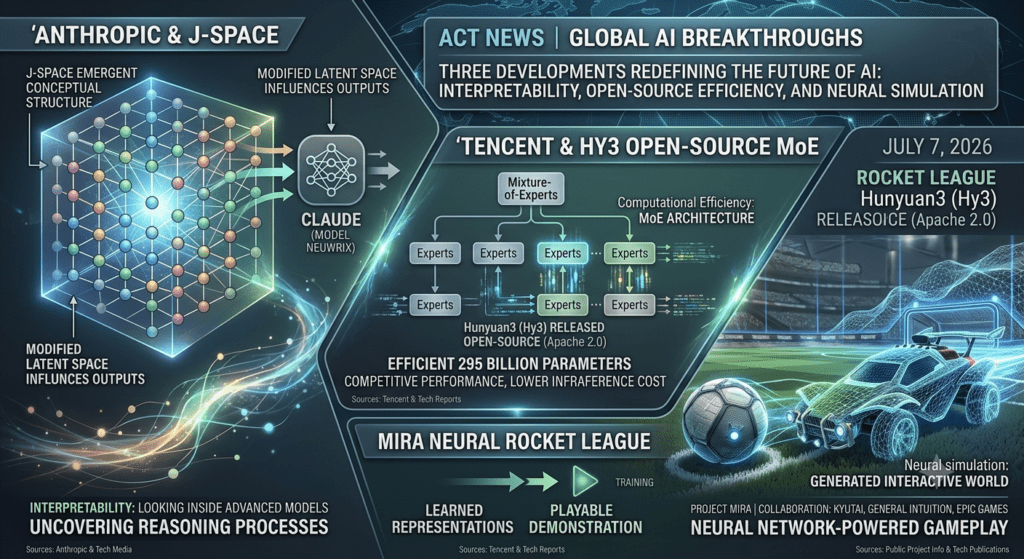
Artificial intelligence research continues to move at an extraordinary pace, with three major developments highlighting how quickly the industry is evolving. Anthropic has announced new research surrounding an internal conceptual structure within its Claude models known as “J-space,” Tencent has released the open-source Hunyuan3 (Hy3) Mixture-of-Experts model under the Apache 2.0 license, and a collaboration between Kyutai, General Intuition, and Epic Games has demonstrated a fully playable neural-network version of Rocket League through the MIRA project. Together, these announcements illustrate how AI is advancing simultaneously in interpretability, open-source innovation, and interactive simulation.
According to information released by Anthropic and covered by technology media, researchers studying Claude identified what they describe as an emergent internal representation called “J-space.” Rather than being explicitly programmed, this structure appears to organize concepts that the model uses during reasoning. Researchers also reported that modifying elements within this latent space can influence how the model responds to prompts, providing a new window into understanding the internal mechanisms of large language models.
For years, one of the biggest criticisms of advanced AI systems has been their “black box” nature. Developers could measure outputs and benchmark performance, but understanding precisely how a model reached a conclusion remained extremely difficult. Anthropic’s findings suggest that researchers may be moving toward a future where reasoning processes become more interpretable rather than remaining hidden inside billions of parameters.
If further validated by the broader scientific community, discoveries like J-space could have implications far beyond academic curiosity. Greater interpretability may help developers detect biases, improve safety mechanisms, identify reasoning errors, and build more transparent AI systems. It may also strengthen confidence among governments, businesses, and users who increasingly rely on AI for decision-making.
From ACT News’ perspective, interpretability is becoming one of the defining challenges of modern artificial intelligence. Building larger models is no longer enough. The next stage of AI development will likely depend on understanding how these systems organize knowledge internally and ensuring that their reasoning aligns with human expectations.
Another significant announcement comes from Tencent, which has released its Hy3 Mixture-of-Experts model as open source under the Apache 2.0 license. The model reportedly contains 295 billion parameters while using the Mixture-of-Experts (MoE) architecture, allowing only portions of the network to activate during inference instead of the entire model.
This design significantly improves computational efficiency while maintaining high performance. According to Tencent and independent technology reporting, Hy3 delivers performance comparable to considerably larger models across multiple benchmarks despite requiring fewer active computational resources.
The decision to publish the model under the Apache 2.0 license also reflects a broader movement toward open AI development. Open-source releases allow researchers, startups, universities, and independent developers to study, improve, and adapt advanced models without relying exclusively on proprietary systems.
Competition between closed and open AI ecosystems has become one of the defining themes of the global technology industry. Companies such as Anthropic, OpenAI, Google, Meta, Alibaba, and Tencent are pursuing different strategies that balance commercial interests, research collaboration, and technological leadership.
ACT News believes that open-source AI will continue playing a critical role in global innovation. While proprietary models often lead in commercial deployment, open ecosystems encourage broader experimentation, accelerate academic research, and reduce barriers for emerging developers worldwide. Maintaining a healthy balance between commercial investment and collaborative research could prove essential for sustaining long-term innovation.
The third major development demonstrates that artificial intelligence is expanding beyond language into entirely new forms of interactive digital environments.
The MIRA project, developed through a collaboration involving Kyutai, General Intuition, and Epic Games, has introduced a neural-network-powered version of Rocket League that is fully playable. Rather than relying exclusively on conventional game engines, the system generates gameplay through learned neural representations, showcasing an entirely different approach to interactive simulation.
Neural simulation has been an active research area for several years, but playable demonstrations remain relatively rare. The ability to generate complex, responsive environments through machine learning represents a significant technical achievement and may influence the future of gaming, robotics, simulation, and digital content creation.
Projects like MIRA suggest that future AI systems may not simply generate text, images, or videos. They could eventually generate complete interactive worlds that respond dynamically to user behavior while learning from experience.
This technology could have applications extending well beyond entertainment. Training simulations for autonomous vehicles, robotics research, engineering, education, virtual collaboration, and scientific experimentation could all benefit from increasingly realistic neural environments capable of adapting in real time.
According to publicly available information from the organizations involved, MIRA represents an important research milestone rather than a commercial product. Nevertheless, it illustrates the growing convergence between artificial intelligence and interactive computing.
Viewed together, these three announcements reveal several important trends shaping the future of AI.
First, researchers are beginning to look inside advanced models instead of treating them purely as prediction engines. Understanding internal representations such as Anthropic’s J-space could eventually improve transparency, accountability, and trust.
Second, efficiency is becoming as important as scale. Tencent’s Hy3 demonstrates that smarter architectures like Mixture-of-Experts can achieve competitive performance without simply increasing computational requirements indefinitely.
Third, artificial intelligence is rapidly moving beyond traditional language generation. Neural simulations like MIRA indicate that AI may become a foundation for creating interactive digital experiences that merge machine learning with physics, graphics, and human interaction.
At the same time, these advances also raise important questions. Greater model interpretability may require new standards for transparency. Open-source releases may accelerate innovation while also increasing the need for responsible governance. Neural world generation introduces fresh debates surrounding copyright, digital authenticity, safety, and the future of creative industries.
Technology experts from organizations including Anthropic, Tencent, and research collaborators such as Kyutai and General Intuition have emphasized that these projects represent ongoing scientific work rather than finished products. Continued peer review, independent validation, and real-world testing will determine how these innovations mature over time.
For ACT News, the broader story extends beyond any single announcement. Artificial intelligence is entering a phase where progress is no longer defined solely by larger datasets or more powerful hardware. Instead, the industry is beginning to focus on understanding reasoning, improving efficiency, and expanding AI into increasingly interactive environments.
The next generation of artificial intelligence will likely be judged not only by how intelligent models appear, but by how transparent they become, how efficiently they operate, and how safely they integrate into everyday life. The developments from Anthropic, Tencent, and the MIRA collaboration provide three distinct examples of this transformation, each pointing toward a future where AI is becoming more explainable, more accessible, and more deeply integrated into the digital experiences that shape modern society.
Sources referenced in this analysis include announcements and research from Anthropic, Tencent, Kyutai, General Intuition, Epic Games, and reporting from leading international technology publications covering these developments.
Stay Connected
Follow ACT News for real-time updates, breaking stories, and in-depth coverage from around the world.
Never Miss a Story
Join our WhatsApp Channel and get breaking news straight to your phone.
Join WhatsApp Channel →