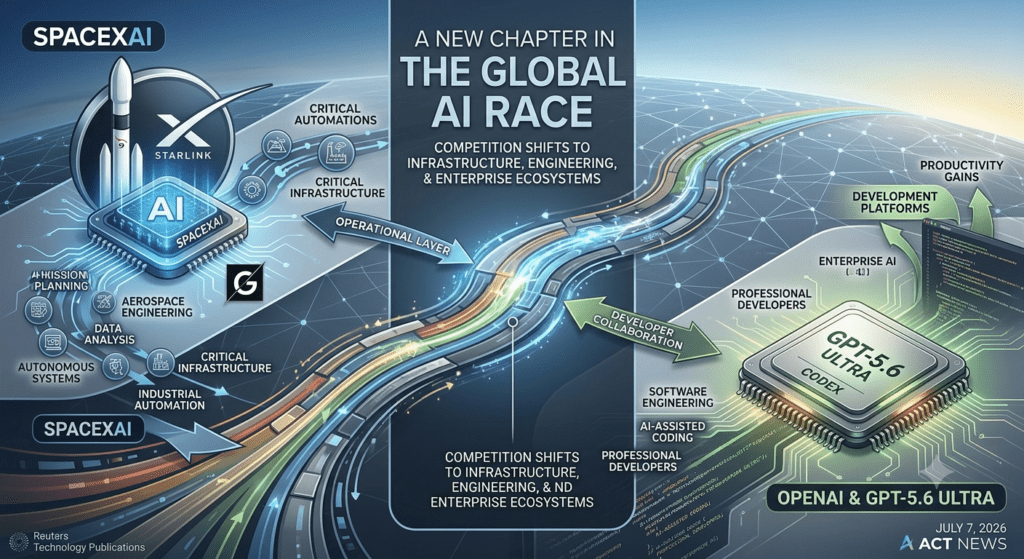
Elon Musk has officially rebranded xAI as SpaceXAI, marking a major strategic shift that places artificial intelligence at the center of the broader SpaceX ecosystem. The move follows the deeper integration of AI operations into Musk’s aerospace business, with Grok, the company’s flagship AI assistant, now operating under the new SpaceXAI identity.
The announcement comes as OpenAI expands its own position in enterprise AI by introducing GPT-5.6 Ultra to Codex, its programming-focused environment. Together, the two developments highlight how competition in artificial intelligence is moving far beyond chatbots and into critical infrastructure, software engineering, industrial automation, and the next generation of technological innovation.
According to company announcements and reporting from organizations including Reuters and other technology publications, both announcements reflect a broader transformation taking place across the AI industry. Rather than competing solely over who builds the most capable language model, leading technology companies are increasingly competing to build complete ecosystems that combine software, infrastructure, computing power, and specialized applications.
SpaceXAI: More Than a Corporate Rebrand
While the renaming of xAI to SpaceXAI may appear to be a branding exercise at first glance, its strategic implications are considerably larger.
Artificial intelligence is becoming deeply integrated into SpaceX’s expanding technological ecosystem, which already includes launch operations, satellite communications, engineering systems, and global internet infrastructure through Starlink.
Bringing Grok under the SpaceXAI brand suggests that AI is no longer viewed as a standalone business unit. Instead, it becomes another layer of the company’s broader technological architecture, capable of supporting engineering, mission planning, operational efficiency, data analysis, and future autonomous systems.
For years, SpaceX has relied heavily on automation, advanced software, and large-scale data processing. Adding a dedicated AI organization directly into that environment could accelerate innovation across multiple sectors, including aerospace engineering, satellite management, robotics, logistics, and potentially future deep-space exploration.
Although SpaceX has not publicly detailed every aspect of its long-term AI roadmap, industry observers have increasingly pointed to the convergence between aerospace technology and artificial intelligence as one of the defining trends of the coming decade.
Grok Enters a New Stage
Grok remains one of the most recognizable AI assistants developed outside the traditional AI leaders.
Operating under SpaceXAI could significantly expand its role beyond conversational interactions. Future applications may include technical assistance for engineers, support for complex operational workflows, automation of internal systems, and advanced analysis of engineering data.
Unlike consumer-focused AI products that primarily answer questions or generate content, AI integrated into industrial environments often performs tasks that directly influence productivity, infrastructure management, and operational decision-making.
That distinction is becoming increasingly important as businesses seek measurable returns from AI investments.
OpenAI Strengthens Its Position Among Developers
While Musk’s strategy focuses on infrastructure integration, OpenAI continues strengthening its position among software developers.
The release of GPT-5.6 Ultra inside Codex demonstrates the company’s continued investment in AI-assisted programming.
Programming assistants have rapidly evolved into essential tools across software development, allowing engineers to generate code, detect bugs, explain complex functions, and accelerate production cycles.
The introduction of an Ultra variant suggests that OpenAI is expanding capabilities for professional developers working on increasingly sophisticated software projects.
As enterprise demand for AI-assisted coding continues to grow, development platforms themselves are becoming one of the industry’s most competitive battlegrounds.
Rather than competing only for general consumers, AI companies are now competing for businesses, engineering teams, research organizations, and governments seeking productivity gains.
AI Competition Is Becoming an Infrastructure Race
Only a few years ago, most public discussion around artificial intelligence centered on chatbots.
Today’s announcements tell a different story.
Leading AI companies are investing simultaneously in:
- Cloud infrastructure.
- High-performance computing.
- Specialized chips.
- Enterprise software.
- Autonomous systems.
- Scientific research.
- Robotics.
- Aerospace technologies.
This evolution reflects a broader industry transition where artificial intelligence increasingly functions as critical infrastructure rather than simply another digital service.
Companies capable of combining AI with physical assets—whether satellites, factories, logistics networks, or cloud platforms—may enjoy significant long-term competitive advantages.
ACT News Analysis
From ACT News’ perspective, the announcements from SpaceXAI and OpenAI represent two different—but equally important—visions for the future of artificial intelligence.
SpaceXAI appears focused on integrating AI directly into physical infrastructure. By combining aerospace technology, communications systems, and advanced machine learning, the company is positioning artificial intelligence as an operational layer capable of supporting increasingly complex engineering challenges.
OpenAI, meanwhile, continues expanding AI’s role within software creation itself. By improving developer-focused tools such as Codex, the company reinforces the idea that AI will become an everyday collaborator for programmers rather than simply an external assistant.
Neither strategy excludes the other. In fact, both illustrate how artificial intelligence is becoming embedded across every layer of the digital economy—from writing software to operating satellites.
Competition is therefore shifting away from isolated model comparisons toward complete ecosystems capable of delivering computing power, specialized services, developer platforms, enterprise integration, and scalable infrastructure.
This trend is likely to influence investment priorities, workforce development, regulatory discussions, and international technology policy for years to come.
As governments increasingly recognize AI as both an economic opportunity and a strategic capability, collaboration between private companies and public institutions may become even more significant.
The emergence of SpaceXAI and the continued expansion of OpenAI’s professional tools underscore one central reality: the next phase of artificial intelligence will not be defined solely by smarter models, but by how effectively those models are integrated into the systems that power modern economies.
Follow ACT News for in-depth coverage of artificial intelligence, emerging technologies, innovation, and the global competition shaping the future of digital transformation.
Stay Connected
Follow ACT News for real-time updates, breaking stories, and in-depth coverage from around the world.
Never Miss a Story
Join our WhatsApp Channel and get breaking news straight to your phone.
Join WhatsApp Channel →