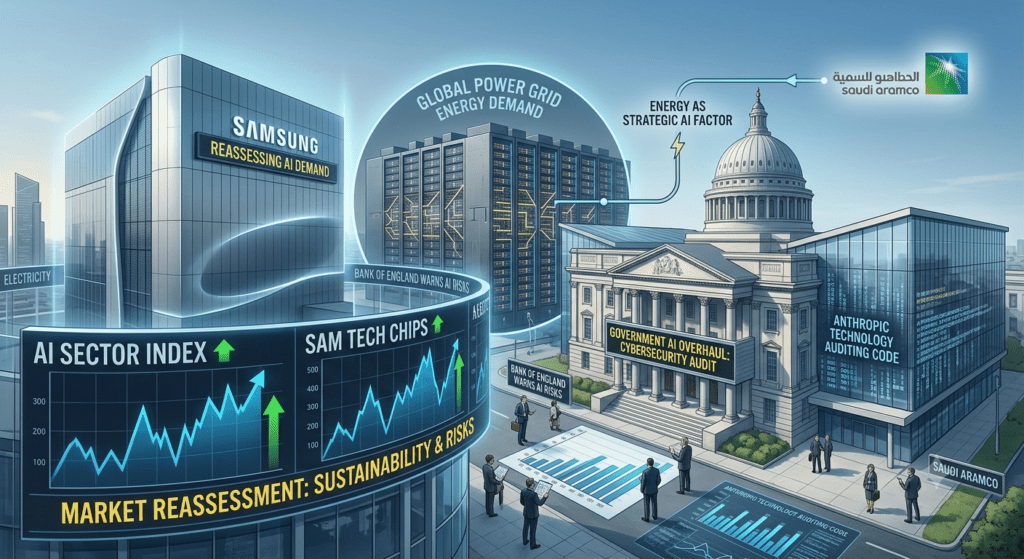
The global artificial intelligence revolution continues to reshape markets, industries and government strategies, but new concerns are emerging about whether the current AI boom can maintain its rapid pace.
Recent developments involving Samsung Electronics, Wall Street banks, cybersecurity agencies and central banks show that artificial intelligence has moved from being only a technology race into a broader economic and financial challenge.
While investors continue searching for opportunities linked to AI, companies and policymakers are increasingly focused on sustainability, risks and long-term impacts.
Samsung results highlight growing AI market uncertainty
Samsung has reported expectations of a significant increase in profits, supported by demand connected to the semiconductor industry. However, despite stronger financial performance, investor reactions have shown concerns about the future direction of the AI market.
According to reports from international financial media, shares faced pressure as investors questioned whether the current AI expansion can continue at the same speed.
The semiconductor industry has become one of the main beneficiaries of artificial intelligence growth, with companies competing to supply advanced chips required for powerful computing systems.
ACT News Analysis:
The reaction around Samsung reflects a broader market question: is artificial intelligence entering a period of sustainable growth, or are investors becoming too optimistic about short-term expectations?
The technology sector has experienced similar cycles in the past, where strong innovation was followed by periods of adjustment as markets reassessed valuations and demand.
The long-term importance of AI remains significant, but companies will need to demonstrate real-world profits, not only future promises.
Wall Street looks for opportunities as SpaceX attracts investors
Financial markets are also paying close attention to the growing influence of private technology companies.
Reports indicate that increased trading activity connected to expectations around SpaceX has generated optimism among financial institutions.
The possibility of major technology companies entering public markets has created new opportunities for investors while increasing discussions about valuation and market concentration.
ACT News Analysis:
The technology sector continues to redefine traditional investment strategies.
Companies involved in artificial intelligence, aerospace and advanced technology are attracting capital at a scale previously associated mainly with established industries.
However, investors face a challenge: distinguishing between companies with strong long-term fundamentals and those benefiting mainly from market excitement.
US cybersecurity agency expands AI oversight
Artificial intelligence is also becoming increasingly important in government operations.
Reports indicate that a US cybersecurity agency is using Anthropic’s AI technology to assist with government code auditing.
The move reflects a growing trend among governments: using AI tools to improve efficiency while also addressing concerns about security and reliability.
ACT News Analysis:
Government adoption of AI represents a major turning point.
Public institutions are increasingly exploring how artificial intelligence can improve services, analyze information and strengthen cybersecurity.
At the same time, the use of AI in government systems requires strict oversight to prevent errors, vulnerabilities or unintended consequences.
China’s gig economy reveals labor challenges
China’s expanding gig economy has created millions of opportunities for workers, especially in delivery, transportation and online services.
However, reports indicate that the growth of flexible employment is also revealing deeper challenges in the labor market, including income pressure and questions about social protection.
ACT News Analysis:
The gig economy represents one of the biggest transformations in modern employment.
While it provides flexibility and new income sources, governments worldwide are facing the challenge of creating systems that protect workers without limiting innovation.
China’s experience reflects a global debate about the future of work in a technology-driven economy.
Financial institutions warn about AI risks
Central banks and financial regulators are increasingly studying the potential risks created by artificial intelligence.
The Bank of England has warned about possible financial stability concerns related to AI, while European regulators are encouraging banks to prepare plans against AI-driven disruptions.
Potential risks include cyberattacks, automated decision-making failures and increased market volatility.
ACT News Analysis:
The financial sector understands that AI can be both an opportunity and a vulnerability.
Banks are investing heavily in artificial intelligence to improve services, detect fraud and manage risks. However, the same technology could also create new forms of financial instability if not properly controlled.
Energy becomes a strategic factor in the AI race
Artificial intelligence requires enormous computing power, and computing power requires energy.
Reports that Saudi Arabia is considering oil infrastructure expansion and that energy companies are increasing production guidance highlight how traditional energy markets remain connected to new technology trends.
ACT News Analysis:
The AI revolution is also an energy revolution.
The future of artificial intelligence will depend not only on chips and software but also on access to reliable and affordable electricity.
Countries with strong energy systems may gain advantages in attracting data centers and technology investment.
A new phase of the AI revolution
The latest developments suggest that artificial intelligence is entering a more mature stage.
The first phase was driven by excitement and rapid investment. The next phase will likely focus on efficiency, profitability, regulation and risk management.
For ACT News, the central question is no longer whether AI will transform the world — that transformation has already begun.
The key challenge now is determining how governments, companies and societies will manage this change.
Artificial intelligence promises enormous opportunities, but the winners of the next decade will likely be those who combine innovation with responsibility, security and long-term planning.
Stay Connected
Follow ACT News for real-time updates, breaking stories, and in-depth coverage from around the world.
Never Miss a Story
Join our WhatsApp Channel and get breaking news straight to your phone.
Join WhatsApp Channel →