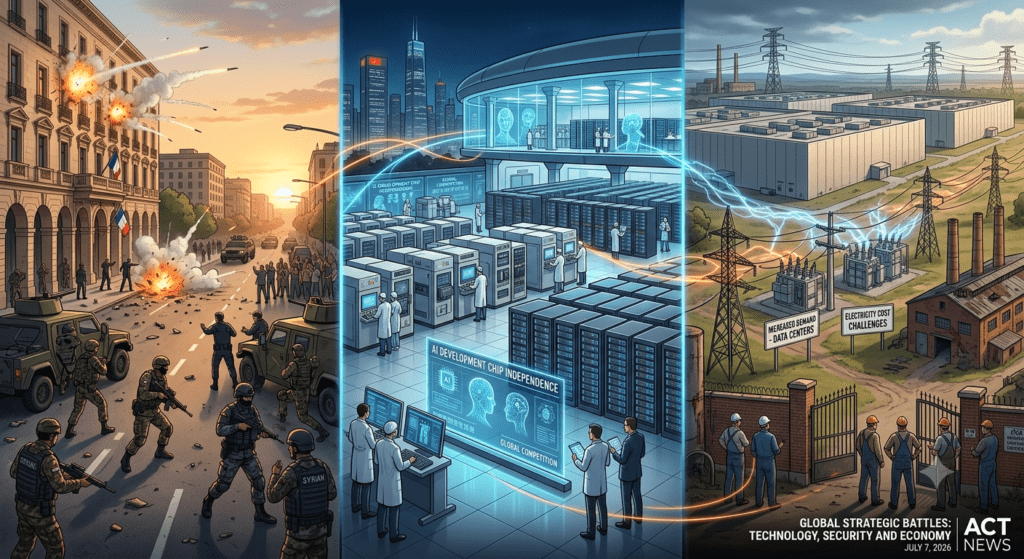
The latest international developments highlight a world increasingly shaped by security concerns, technological competition and economic transformation. From explosions reported in Damascus during the visit of French President Emmanuel Macron to China’s efforts to strengthen its artificial intelligence industry and the growing energy demands created by American technology expansion, governments are facing new challenges that go beyond traditional politics.
These events demonstrate how security, innovation and economic power are becoming deeply connected in global affairs.
Explosions in Damascus raise security concerns during Macron visit
Reports of explosive devices detonating near a hotel in Damascus, where French President Emmanuel Macron was expected to stay, have drawn international attention and renewed discussions about security challenges in Syria.
According to international media reports, the incident occurred during Macron’s visit to Damascus, a trip viewed as a significant diplomatic moment following major political changes in the country.
French officials indicated that Macron was not affected and that his schedule continued. However, the incident highlighted the fragile security environment that continues to surround Syria after years of conflict and political instability.
ACT News Analysis:
The event demonstrates the complexity facing international leaders when engaging with countries undergoing political transitions. Diplomatic visits often carry symbolic importance, but they also require extensive security coordination in regions where multiple interests and groups remain active.
For Europe, Syria represents both a security challenge and a diplomatic opportunity, particularly regarding migration, regional stability and reconstruction efforts.
China accelerates artificial intelligence strategy
China’s artificial intelligence sector is becoming one of the most important areas of global technological competition.
Reports indicate that Beijing is considering measures that could limit international access to some of its leading AI models, while Chinese companies continue developing domestic technologies to compete with American firms.
One of the companies receiving international attention is DeepSeek, which has reportedly been working on its own AI chip development.
The competition reflects a broader global race involving software, semiconductor production and technological independence.
ACT News Analysis:
Artificial intelligence is no longer only a business sector. It has become a strategic issue connected to national security, economic growth and global influence.
The United States, China and other technological powers are increasingly treating AI infrastructure as a key element of future competitiveness.
The countries that control advanced chips, computing capacity and AI systems may gain significant advantages in industries ranging from manufacturing to defense.
Energy pressure grows as AI data centers expand in the United States
The rapid expansion of artificial intelligence infrastructure is creating new economic challenges inside the United States.
According to Reuters, some companies in America’s industrial regions are experiencing higher electricity costs due to increased demand from large data centers operated by major technology companies.
The Rust Belt, historically known for manufacturing, is now becoming an important location for technology infrastructure. However, this transformation is creating debates about energy supply, costs and the impact on traditional industries.
ACT News Analysis:
The AI revolution requires enormous amounts of electricity. While artificial intelligence promises economic opportunities, it also creates new pressure on energy systems.
The challenge for governments will be balancing technological development with affordable energy for businesses and households.
The future competition in AI may depend not only on algorithms and chips but also on access to reliable power.
Political uncertainty continues in the United Kingdom
Another political development involves Nigel Farage, who is expected to make a statement about his political future.
Farage has remained one of the most influential figures in British politics, particularly through debates surrounding immigration, national identity and the relationship between the United Kingdom and international institutions.
Any announcement regarding his future could influence the direction of the Reform UK movement and the broader political landscape.
ACT News Analysis:
Across many democracies, political figures outside traditional parties have gained influence by presenting themselves as alternatives to established systems.
The rise of movements like Reform UK reflects a wider global trend: voters increasingly seek political options that challenge conventional structures.
American politics enters another period of debate
In the United States, domestic political discussions continue around healthcare policy, the Supreme Court and investigations involving high-profile cases.
Healthcare remains a major issue ahead of future elections, with both major parties attempting to shape public opinion around affordability, access and government responsibility.
Meanwhile, legal and political debates continue to influence the national conversation.
ACT News Analysis:
American politics remains deeply connected to public concerns about everyday life, including healthcare costs, economic conditions and trust in institutions.
As elections approach, issues affecting ordinary citizens often become more influential than broader ideological debates.
A changing world defined by technology and security
The events unfolding across Damascus, Beijing, Washington and London reveal a common pattern: the global landscape is being reshaped by new forms of competition.
Security threats are evolving. Artificial intelligence is changing economies. Energy demand is becoming a strategic issue. Political movements are challenging traditional structures.
For ACT News, the key lesson is that modern international affairs cannot be understood through a single perspective.
Military power, technology, economics and public opinion are increasingly connected.
The countries and leaders capable of adapting to these changes will likely have the greatest influence in the next era of global competition.
Stay Connected
Follow ACT News for real-time updates, breaking stories, and in-depth coverage from around the world.
Never Miss a Story
Join our WhatsApp Channel and get breaking news straight to your phone.
Join WhatsApp Channel →